
Fatigue is one of the most common complaints in outpatient medicine. Patients describe it in many ways: “I’m always tired,” “I have no energy,” “I feel wiped out,” or “I just don’t feel like myself.” Providers document it in primary care, internal medicine, oncology, endocrinology, behavioral health and almost every other specialty.
Because it’s so common, fatigue is also easy to code incorrectly. The ICD-10 code for fatigue in most cases is R53.83, Other fatigue. But ICD-10-CM has several related codes in the same category, including codes for chronic fatigue, malaise, weakness and cancer-related fatigue. Some fatigue-related conditions, such as myalgic encephalomyelitis/chronic fatigue syndrome, are classified in a completely different chapter.
Choosing the wrong code can lead to inaccurate records, medical necessity problems and avoidable claim denials. Choosing a symptom code when the provider has already confirmed the cause can also affect claim review.
This guide explains R53.83, the related R53 codes, how to tell fatigue apart from malaise and weakness, when R53.83 can be the first-listed diagnosis, what documentation supports it and how fatigue coding affects medical billing services.
What Is the ICD-10 Code for Fatigue?
The ICD-10-CM code for other fatigue is R53.83. It includes fatigue NOS, lack of energy, lethargy and tiredness.
R53.83 is used when a provider documents fatigue, tiredness or a lack of energy and no more specific code describes the condition. It belongs to Chapter 18 of ICD-10-CM, which covers symptoms, signs and abnormal clinical and laboratory findings not classified elsewhere.
Here is where R53.83 sits in the code hierarchy:
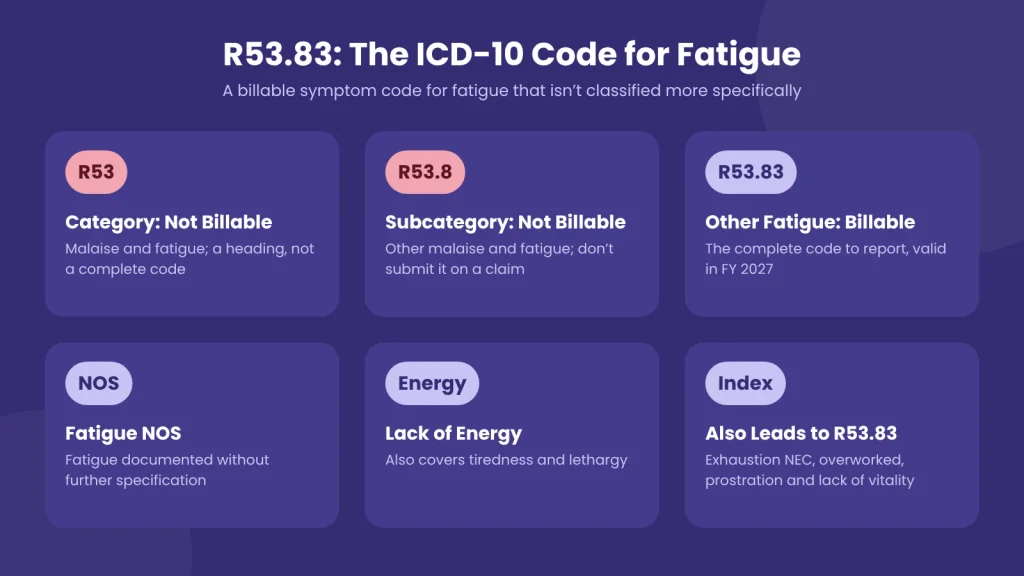
| Level | Code | Description | Billable? |
| Category | R53 | Malaise and fatigue | No |
| Subcategory | R53.8 | Other malaise and fatigue | No |
| Code | R53.83 | Other fatigue | Yes |
R53 and R53.8 are non-billable category and subcategory codes. They shouldn’t be submitted as complete diagnosis codes. Some online references describe R53 itself as billable, but it’s a category heading. A claim should carry the complete code, R53.83, or another complete code from the category.
R53.83 Inclusion Terms
The Tabular List lists four inclusion terms under R53.83:
- Fatigue NOS (not otherwise specified)
- Lack of energy
- Lethargy
- Tiredness
The Alphabetic Index also leads several related terms to R53.83, including exhaustion (physical, not elsewhere classified), overworked, overstrained, prostration and lack of vitality.
That’s why searches for “ICD-10 lethargy,” “ICD-10 code for tiredness,” “low energy ICD-10” and “ICD-10 code for exhaustion” usually point to the same code. But the exact documented term still matters. Some types of exhaustion are classified elsewhere, as explained below.
Code Assignment Depends on Documentation
R53.83 should reflect what the provider actually documented. A coder shouldn’t add fatigue because the patient mentioned feeling tired in the history, and shouldn’t choose R53.83 if the provider has diagnosed a condition that explains the fatigue. The provider’s assessment drives the code.
R53.83 Diagnosis Code: Description, Meaning and Usage
What Does R53.83 Mean?
The official description of R53.83 is Other fatigue. “Other” in this context means fatigue that isn’t classified to one of the more specific codes in the R53 category, such as chronic fatigue (R53.82) or fatigue related to a malignancy (R53.0).
R53.83 is a symptom code. It describes what the patient is experiencing, not why. That’s an important difference from a confirmed diagnosis:
| Symptom code (R53.83) | Confirmed diagnosis | |
| What it describes | The patient’s complaint | The condition causing the complaint |
| Example | Fatigue | Iron deficiency anemia, hypothyroidism, major depressive disorder |
| When it’s used | Cause not yet established, or symptom not explained by the confirmed condition | Provider has confirmed the condition |
Under the ICD-10-CM Official Guidelines for Coding and Reporting, codes for signs and symptoms are acceptable when the provider hasn’t established a related definitive diagnosis. Signs and symptoms that are routinely associated with a confirmed disease generally shouldn’t be reported separately.
When Should Providers Use R53.83?
R53.83 is usually appropriate in these situations:
- The workup hasn’t started or isn’t finished. A patient reports fatigue, and the provider orders labs to look for a cause.
- Testing doesn’t identify a cause. Lab results are normal and the provider documents fatigue without a further diagnosis.
- The fatigue isn’t routinely part of a confirmed condition. The provider documents fatigue as a separate clinical problem that adds information.
- Fatigue is the reason for the encounter and no definitive diagnosis has been made.
R53.83 shouldn’t be used when:
- The provider has confirmed a condition that explains the fatigue, and fatigue is a routine feature of it.
- The documentation supports a more specific code, such as R53.82, R53.0 or G93.32.
- The fatigue is described in a way the Tabular List excludes, such as fatigue due to pregnancy or heat.
Is R53.83 a Billable ICD-10-CM Code?
Yes. R53.83 is a billable, specific ICD-10-CM code that can be reported on claims. It remains valid in the FY 2027 ICD-10-CM code set, which applies to encounters from October 1, 2026 through September 30, 2027.
Billable status only means the code is valid on a claim. Whether a particular service is paid still depends on the payer’s medical necessity rules and the supporting documentation.
Related ICD-10 Codes for Fatigue, Malaise and Weakness

The R53 category contains several codes that are easy to confuse:
| ICD-10-CM code | Description | Use when the provider documents |
| R53.83 | Other fatigue | Fatigue, tiredness, lack of energy or lethargy, not otherwise classified |
| R53.82 | Chronic fatigue, unspecified | Chronic fatigue that isn’t a diagnosed fatigue syndrome |
| R53.81 | Other malaise | Malaise, debility or general physical deterioration |
| R53.1 | Weakness | Generalized weakness or asthenia |
| R53.0 | Neoplastic (malignant) related fatigue | Fatigue linked by the provider to a malignancy |
Excludes1 Notes for R53.8
The subcategory R53.8 (which includes R53.81, R53.82 and R53.83) carries an Excludes1 note. An Excludes1 note generally means the conditions listed are coded elsewhere and shouldn’t be reported with these codes. The listed conditions include:
| Condition | Correct code |
| Combat exhaustion and fatigue | F43.0 |
| Congenital debility | P96.9 |
| Exhaustion and fatigue due to excessive exertion | T73.3 |
| Exhaustion and fatigue due to exposure | T73.2 |
| Exhaustion and fatigue due to heat | T67.- |
| Exhaustion and fatigue due to pregnancy | O26.8- |
| Exhaustion and fatigue due to recurrent depressive episode | F33.- |
| Exhaustion and fatigue due to senile debility | R54 |
The Excludes1 exception. The ICD-10-CM guidelines allow an exception when the two conditions are unrelated to each other. If the provider documents two separate conditions that aren’t connected, both codes may be reported even though an Excludes1 note appears. For example, if a pregnant patient’s fatigue is documented as caused by something unrelated to the pregnancy, the Excludes1 note for pregnancy-related fatigue doesn’t automatically block the fatigue code. The documentation must make clear that the conditions are unrelated. When in doubt, query the provider.
R53.83 itself also has an Excludes2 note for exhaustion and fatigue due to a depressive episode (F32.-). An Excludes2 note means the condition isn’t part of R53.83, but both codes can be reported together when both are documented and appropriate.
ICD-10 Code for Chronic Fatigue – R53.82
R53.82 is Chronic fatigue, unspecified. It’s used when the provider documents chronic fatigue but doesn’t diagnose a defined fatigue syndrome.
How it differs from R53.83:
- R53.83 covers fatigue in general, without a documented chronic course.
- R53.82 requires the provider to describe the fatigue as chronic.
ICD-10-CM doesn’t define a minimum duration for “chronic” in this code, so coders shouldn’t assign R53.82 based on how long the patient says they’ve been tired. The provider must document the fatigue as chronic.
Chronic fatigue syndrome isn’t R53.82. This is one of the most common errors in fatigue coding. R53.82 carries an Excludes1 note for the following conditions, which have their own codes under G93.3:
| Condition | Correct code |
| Myalgic encephalomyelitis / chronic fatigue syndrome (ME/CFS) | G93.32 |
| Postviral fatigue syndrome | G93.31 |
| Other post infection and related fatigue syndromes | G93.39 |
These G93.3- codes sit in Chapter 6, Diseases of the Nervous System. They were added in FY 2023, giving ME/CFS its own code for the first time. The G93.3 subcategory also instructs coders to use an additional code, if applicable, for post COVID-19 condition (U09.9).
So “chronic fatigue” documented by the provider goes to R53.82, while “chronic fatigue syndrome” or “ME/CFS” goes to G93.32. The difference is one word, and it changes the chapter, the code and how the condition is tracked.
ICD-10 Code for Malaise – R53.81
R53.81 is Other malaise. Its inclusion terms are:
- Chronic debility
- Debility NOS
- General physical deterioration
- Malaise NOS
- Nervous debility
R53.81 has its own Excludes1 note for age-related physical debility (R54). If the provider attributes the patient’s debility to aging, R54 is the correct code.
Searches for the “ICD-10 code for malaise” lead to R53.81. The difference between malaise and fatigue is covered in its own section below.
ICD-10 Code for Weakness – R53.1
R53.1 is Weakness, which includes asthenia NOS. It describes a generalized lack of strength.
Weakness and fatigue aren’t the same symptom:
- Fatigue is a lack of energy or a feeling of tiredness. The patient may be able to do a task but feels exhausted.
- Weakness is a reduction in physical strength. The patient may not be able to lift, grip or stand as expected.
R53.1 has an Excludes1 note for several conditions coded elsewhere:
| Condition | Correct code |
| Age-related weakness | R54 |
| Muscle weakness (generalized) | M62.81 |
| Sarcopenia | M62.84 |
| Senile asthenia | R54 |
A common example: a provider documents “generalized muscle weakness.” That’s M62.81, not R53.1. If the provider documents both weakness and fatigue as separate findings, both symptoms can be coded when appropriate.
ICD-10 Code for Neoplastic-Related Fatigue – R53.0
R53.0 is Neoplastic (malignant) related fatigue, sometimes called cancer-related fatigue. Fatigue in cancer patients can come from the cancer itself or from its treatment, and ICD-10-CM codes those two situations differently.
Fatigue related to the cancer (R53.0):
- R53.0 is used when the provider documents that the fatigue is related to the malignancy.
- R53.0 carries a “code first” instruction for the associated neoplasm. The cancer code is sequenced first, followed by R53.0. For example, fatigue related to breast cancer would be coded with the appropriate C50.- code first, then R53.0.
- The provider must link the fatigue to the cancer. A patient with cancer who also reports fatigue doesn’t automatically get R53.0.
Fatigue related to cancer treatment:
- When the provider attributes fatigue to chemotherapy, immunotherapy, radiation therapy, or another treatment, the coding approach may differ from that used for neoplasm-related fatigue (R53.0).
- Coders should review the documented cause of fatigue and determine whether it represents an adverse effect of treatment. Apply the relevant guidelines and sequencing rules in the current ICD-10-CM Official Guidelines.
- When a drug is correctly prescribed and properly administered but causes an adverse effect, the nature of the adverse effect is generally coded first, followed by the appropriate drug-specific adverse-effect code from categories T36–T50, subject to applicable coding instructions.
- Radiation-related effects follow their own applicable coding and sequencing instructions.
If the documentation doesn’t make clear whether the fatigue comes from the cancer or the treatment, query the provider before choosing a code. Practices that treat cancer patients often see this scenario. Our oncology billing services cover these sequencing rules.
Other Codes Often Confused With Fatigue

| Documented condition | Code | Note |
| Age-related physical debility (frailty, senility) | R54 | Use when debility is attributed to age |
| Somnolence or drowsiness | R40.0 | A different symptom from fatigue |
| Burn-out | Z73.0 | A factor influencing health status, not a fatigue code |
| Neurasthenia | F48.8 | Excluded from the G93.3- fatigue syndromes |
| Post COVID-19 condition | U09.9 | Used with the condition it causes, per guidelines |
ICD-10 Code for Fatigue and Malaise: What Is the Difference?
Patients and providers often use “fatigue” and “malaise” together. ICD-10-CM treats them as two different symptoms with two different codes.
| Fatigue | Malaise | |
| Definition | A feeling of tiredness or lack of energy | A general feeling of discomfort, illness or being unwell |
| Typical patient description | “I’m exhausted,” “I have no energy” | “I just don’t feel well,” “Something’s off” |
| ICD-10-CM code | R53.83 | R53.81 |
| Inclusion terms | Fatigue NOS, lack of energy, lethargy, tiredness | Malaise NOS, debility NOS, chronic debility, general physical deterioration, nervous debility |
When both are documented, both codes can be reported. There’s no single combination code for “malaise and fatigue” in ICD-10-CM. A provider who documents “malaise and fatigue” as separate findings supports both R53.81 and R53.83.
When only one is documented, code only that one. Don’t add R53.81 because the patient has fatigue, or R53.83 because the patient has malaise.
Searches for “ICD-10 for malaise and fatigue” or “malaise and fatigue ICD-10” usually lead to this answer: two separate codes, R53.81 and R53.83, each supported by its own documentation.
Can R53.83 Be Used as a Primary Diagnosis?
Yes, in the right circumstances. R53.83 can be the first-listed diagnosis when fatigue is the main reason for the encounter and the provider hasn’t established a more definitive diagnosis.
In outpatient settings, the ICD-10-CM guidelines direct coders to list first the diagnosis, condition, problem or other reason chiefly responsible for the encounter. When a definitive diagnosis hasn’t been established, codes for symptoms and signs are acceptable.
Outpatient coding also has an important rule about uncertain diagnoses. Terms such as “probable,” “suspected,” “rule out” or “working diagnosis” aren’t coded as if the condition were confirmed. Instead, the symptoms are coded. So a note that says “fatigue, rule out hypothyroidism” supports R53.83, not a hypothyroidism code.
Examples:
| Scenario | First-listed diagnosis |
| New patient reports three weeks of fatigue. Provider orders a CBC, TSH and metabolic panel. No diagnosis yet. | R53.83 |
| Follow-up visit. Labs show iron deficiency anemia, which the provider documents as the cause of the fatigue. | D50.9 (fatigue is a routine feature, so it’s generally not coded separately) |
| Provider documents “fatigue, probable depression.” | R53.83 (the uncertain diagnosis isn’t coded in outpatient settings) |
| Provider diagnoses ME/CFS. | G93.32 (not R53.82 or R53.83) |
| Oncology patient with provider-documented cancer-related fatigue | The neoplasm code first, then R53.0 |

When an Underlying Condition Is More Appropriate
Once the provider confirms a cause, that condition usually becomes the primary diagnosis. Common causes of fatigue include anemia, thyroid disease, diabetes, depression, sleep disorders, infections, heart failure and medication effects. When fatigue is a routine part of the confirmed condition, it generally isn’t coded separately.
Fatigue can still be coded alongside the confirmed condition when it isn’t routinely associated with that condition and the provider documents it as a separate problem.
Payer Considerations
Some payers question claims where a symptom code is the only diagnosis, especially for repeated or high-cost tests. R53.83 often supports an initial workup well, but repeat testing over many visits may draw review if the record never moves toward a diagnosis. Check payer coverage policies for the tests you order, particularly national and local coverage determinations for lab services.
Documentation Requirements for Fatigue Diagnosis Coding
What Should Providers Document?
Clear documentation supports the code and the services billed with it. A strong note for a fatigue encounter includes:
- The patient’s complaint in the patient’s own terms, such as “no energy” or “tired all the time.”
- Duration and onset, such as weeks, months or since a specific event, when clinically relevant.
- Severity and impact on daily activities, work or sleep.
- Associated symptoms, such as weight change, fever, shortness of breath, low mood or sleep problems.
- Relevant examination findings.
- The assessment. State clearly whether fatigue is the working problem, whether it’s chronic and whether it’s linked to another condition or to a treatment.
- The plan, including tests ordered, referrals and follow-up.
- Underlying conditions, once confirmed, and whether the provider links them to the fatigue.
The assessment is the most important part for coding. A coder can’t assign R53.82 if “chronic” isn’t documented, or R53.0 if the provider doesn’t connect the fatigue to the cancer.
Common Documentation and Coding Mistakes

- Using R53.83 when a more specific diagnosis is documented. If the provider confirms anemia or hypothyroidism as the cause, the confirmed condition should usually be coded instead.
- Reporting R53.82 for chronic fatigue syndrome. ME/CFS is G93.32. R53.82 has an Excludes1 note for it.
- Assigning R53.82 without “chronic” in the documentation. Duration alone isn’t enough.
- Confusing weakness with fatigue. Weakness is R53.1 or M62.81, not R53.83.
- Coding malaise and fatigue as one code. They’re two codes, each needing documentation.
- Missing the code-first instruction for R53.0. The neoplasm must be sequenced first.
- Treating treatment-related fatigue as R53.0. Fatigue from chemotherapy or radiation follows the adverse effect guidelines instead.
- Misapplying Excludes1 notes. Fatigue due to pregnancy, heat or excessive exertion is coded elsewhere, unless the documentation shows the conditions are unrelated.
- Coding uncertain diagnoses in outpatient settings. “Rule out” conditions aren’t coded. The symptom is.
- Submitting the non-billable R53 or R53.8 instead of a complete code.
- Using outdated code references. Always use the code set in effect on the date of service.
A routine medical billing audit can show whether these errors are showing up in your claims.
Medical Billing and Claim Considerations for ICD-10 Fatigue Codes
How Diagnosis Codes Support Medical Necessity
Every service on a claim needs a diagnosis that explains why it was performed. For a fatigue workup, R53.83 is often the diagnosis linked to the office visit and to tests such as a complete blood count, thyroid studies or a metabolic panel.
For the claim to hold up, three things need to agree:
- The diagnosis code on the claim
- The clinical notes in the medical record
- The services billed, including the visit level and any tests
If the note supports fatigue but the claim lists a confirmed condition the provider never documented, or the services don’t match the clinical picture, the claim is at risk on review.
Common Claim Denial Risks
- Diagnosis and documentation mismatch. The claim code doesn’t match the provider’s assessment.
- Insufficient specificity. A symptom code is used when a confirmed diagnosis was available.
- Medical necessity concerns. The payer’s coverage policy doesn’t list R53.83 as supporting a specific test.
- Excludes1 conflicts. Two codes that shouldn’t be reported together are both on the claim, without documentation showing the conditions are unrelated.
- Non-billable codes. A category or subcategory code such as R53 is submitted instead of a complete code.
- Payer-specific rules. Some plans limit how often certain tests are covered with a symptom diagnosis.
A structured denial management process helps identify which of these is behind a denial and fix it at the source.
How Accurate Coding Helps Reduce Claim Rework
Correct fatigue coding saves time across the revenue cycle:
- Coding review before submission catches symptom codes that should be confirmed diagnoses, and the other way around.
- Claim scrubbing and validation flags non-billable codes and Excludes1 conflicts before the claim leaves the practice.
- Denial trend monitoring shows whether fatigue-related claims are being denied for the same reason repeatedly.
- Corrected claims and follow-up recovery payment on claims that were denied for fixable reasons. Our accounts receivable management service follows up on these until they’re resolved.
Is There a CPT Code for Fatigue?
No. Fatigue is a diagnosis, so it’s reported with an ICD-10-CM code. CPT codes describe the services performed, such as:
- An office or outpatient evaluation and management (E/M) visit, using codes 99202–99215
- Lab tests ordered during the workup, such as a CBC or thyroid studies
The claim needs both. The CPT code says what the provider did, and the ICD-10-CM code says why. A search for a “CPT code for fatigue” usually means the person needs the ICD-10-CM code, R53.83, linked to the right service codes.
How Medical Coding Services Help Improve Diagnosis Accuracy
Symptom codes like R53.83 look simple, but they depend on a chain of decisions: whether a cause is confirmed, whether fatigue is routine to that cause, whether it’s chronic, whether an Excludes1 note or its exception applies and which code goes first. Professional coding review helps get those decisions right consistently.
iSolve RCM’s medical coding services support practices with:
- Code verification against the current ICD-10-CM Tabular List, Alphabetic Index and Official Guidelines
- Documentation checks to confirm the code matches the provider’s assessment
- Provider query support when the record doesn’t clearly support a code
- Consistency across providers, so the same documentation leads to the same code
- Claim scrubbing to catch non-billable codes and conflicts before submission
Fatigue appears in nearly every specialty, from family practice to endocrinology and behavioral health. We support a wide range of specialties through our outsourced medical billing services.
For more symptom and diagnosis coding guidance, see our guides to neuropathy ICD-10 codes and dysphagia ICD-10 codes. If you’re deciding how to staff coding, our comparison of in-house vs. outsourced medical billing covers the trade-offs.
Improve Coding Accuracy and Claim Performance with iSolve RCM
The ICD-10 code for fatigue is usually R53.83, but accurate coding depends on what the provider documents:
- R53.83 for fatigue, tiredness, lack of energy or lethargy
- R53.82 when the provider documents chronic fatigue
- G93.32 for ME/CFS, not R53.82
- R53.81 for malaise, coded separately from fatigue
- R53.1 or M62.81 for weakness, depending on the documentation
- R53.0 for cancer-related fatigue, with the neoplasm coded first
- Adverse effect coding for treatment-related fatigue, based on the documented cause
- The confirmed condition once the provider identifies the cause
Getting these choices right supports medical necessity, keeps claims consistent with the record and reduces avoidable denials. Always verify codes and instructional notes against the ICD-10-CM code set in effect on the date of service.
Frequently Asked Questions About the ICD-10 Code for Fatigue
What is the ICD-10 code for fatigue?
The ICD-10-CM code for fatigue is R53.83, Other fatigue. It includes fatigue NOS, lack of energy, lethargy and tiredness. Related codes include R53.82 for chronic fatigue, R53.81 for malaise, R53.1 for weakness and R53.0 for cancer-related fatigue.
What does R53.83 mean?
R53.83 means “Other fatigue.” It’s a symptom code for fatigue, tiredness or lack of energy that isn’t classified to a more specific code. It describes the patient’s complaint, not its cause, and it’s used when the provider hasn’t confirmed an underlying condition that explains the fatigue.
Is R53.83 a billable diagnosis code?
Yes. R53.83 is a billable, specific ICD-10-CM code and remains valid in the FY 2027 code set. The category R53 and subcategory R53.8 are non-billable and shouldn’t be submitted as complete diagnosis codes. Payment for a service still depends on payer coverage rules and documentation.
Can R53.83 be used as a primary diagnosis?
Yes, when fatigue is the main reason for the visit and the provider hasn’t established a definitive diagnosis. Once the provider confirms a condition that explains the fatigue, that condition usually becomes the primary diagnosis, and routine symptoms of it generally aren’t coded separately.
What is the ICD-10 code for chronic fatigue?
Chronic fatigue, unspecified is R53.82. The provider must document the fatigue as chronic. Chronic fatigue syndrome, also called myalgic encephalomyelitis or ME/CFS, is a different condition coded to G93.32, and R53.82 has an Excludes1 note for it.
What is the difference between R53.83 and R53.82?
R53.83 is general fatigue without a documented chronic course. R53.82 is fatigue the provider specifically describes as chronic, without a diagnosed fatigue syndrome. Use R53.82 only when “chronic” appears in the provider’s documentation, not because of how long the patient reports being tired.
What is the ICD-10 code for malaise and fatigue?
There’s no single combination code. Malaise is R53.81 and fatigue is R53.83. When the provider documents both as separate findings, both codes can be reported. When only one is documented, report only that code.
What is the ICD-10 code for lethargy?
Lethargy is an inclusion term under R53.83, Other fatigue. Drowsiness or somnolence is a different symptom, coded to R40.0. Choose the code that matches the term the provider actually documented.
What is the ICD-10 code for weakness and fatigue?
Weakness is R53.1 and fatigue is R53.83. They’re separate symptoms, so both can be coded when both are documented. If the provider documents generalized muscle weakness, use M62.81 instead of R53.1. Age-related weakness goes to R54.
Is there a CPT code for fatigue?
No. Fatigue is a diagnosis reported with ICD-10-CM code R53.83 or a related code. CPT codes describe services, such as an E/M visit or lab tests ordered to evaluate fatigue. A clean claim links the right CPT code to the right diagnosis code.