
Between 40 and 64, the annual physical changes character. It’s no longer just a quick check of blood pressure and weight. This is the stretch of life when cancer screenings begin, cardiovascular risk starts to drive decisions, and long-standing conditions like high blood pressure or prediabetes often come up during what was booked as a routine visit.
For the billing team, that makes these visits more complicated. The CPT code 99396 reports the preventive service itself, but a single appointment can also produce lab work, screening tests, vaccines and sometimes a separate problem-oriented visit. Each piece has its own coding rules, its own diagnosis and its own coverage questions.
CPT 99396 is generally used for a periodic comprehensive preventive medicine reevaluation and management service for an established patient aged 40 through 64. This guide covers how the code is defined, who qualifies, how annual physicals are coded and paid, which screening services may be reported alongside it, how to choose diagnosis codes and how to prevent the denials that most often follow these claims.
What Is CPT Code 99396?
CPT 99396 reports a periodic comprehensive preventive medicine reevaluation and management service for an established patient aged 40 through 64. In everyday terms, it’s the code for a routine physical for a patient the practice already knows, within that age range.
CPT 99396 Description and Code Definition
The descriptor for 99396 covers a periodic comprehensive preventive medicine reevaluation and management of an individual. It includes an age- and gender-appropriate history and examination, counseling or anticipatory guidance and risk factor reduction interventions, and the ordering of laboratory and diagnostic procedures, for an established patient aged 40 to 64.
Three words in that description do most of the work:
- Periodic. This is a repeat preventive service for someone already known to the practice, not a first-time workup.
- Reevaluation. The provider updates the history and reassesses risks, rather than building a full baseline from scratch.
- Established. The patient has a qualifying prior relationship with the practice.
The code is chosen because of the patient’s age and status and because the service is preventive. Calling an appointment an “annual physical” on the schedule doesn’t make it a 99396 service. If the visit turns out to be mainly about managing an illness, a problem-oriented E/M code may be the right choice instead.
CPT is maintained and copyrighted by the American Medical Association (AMA). The description above is a paraphrase. Verify exact wording in the current-year CPT codebook.
What Is the Age Limit for CPT Code 99396?
The 99396 age limit is 40 through 64 years, measured on the date of service.
- A patient who is 40 on the visit date qualifies.
- A patient who is 64 on the visit date qualifies.
- A patient who has turned 65, even the day before the visit, moves to the next preventive category, CPT 99397.
Age alone isn’t enough. The patient must also be established.
Is CPT 99396 for New or Established Patients?
CPT 99396 is for established patients only. A new patient aged 40–64 is reported with CPT 99386.
Under CPT, a patient is established if they’ve received professional services within the past three years from the same physician or other qualified healthcare professional, or from another physician or QHP of the exact same specialty and subspecialty in the same group practice. If no such service occurred in that window, the patient is new, even if they’ve been to the practice before.
Two situations trip practices up:
- A long gap. A patient who last visited four years ago and has had no other qualifying professional services from the same specialty and subspecialty in the group since then is new under CPT, even though the front desk may think of them as a returning patient. The visit is 99386, not 99396.
- A different specialty in the same group. A patient who sees the group’s gastroenterologist regularly can still be new to the group’s internist.
What Is Included in a CPT 99396 Preventive Visit?
A 99396 visit reassesses the patient’s health and updates their preventive plan. The content depends on the patient’s age, sex and risk factors, and it typically looks different at 42 than at 62.
Preventive History and Risk Assessment
Because the patient is established, the history focuses on what has changed since the last visit:
- Updates to medical and surgical history, including new diagnoses or procedures
- Changes in family history, such as a parent or sibling with a new cancer or heart disease diagnosis
- Social history, including tobacco, alcohol and drug use, diet, physical activity, sleep and work stress
- Medication and allergy review
- Review of age-appropriate risks, such as cardiovascular risk, cancer risk and fall risk later in this age range
Comprehensive Physical Examination
The examination should be appropriate to the patient’s age, sex and risk factors. It typically includes vital signs, weight and BMI, and an examination of the relevant body systems. CPT doesn’t require a fixed head-to-toe exam for preventive services. What matters is that the documentation describes the age- and risk-appropriate examination the provider actually performed, so a reviewer can see that the visit was a comprehensive preventive evaluation rather than a brief problem-focused check.
Counseling and Preventive Guidance
Counseling and risk-factor reduction are built into 99396. Common topics for this age group include:
- Diet, physical activity and weight management
- Tobacco cessation and alcohol use
- Cardiovascular risk and blood pressure control
- Which cancer screenings are due and the options for each
- Immunizations due, such as influenza, and shingles vaccination starting at age 50
- Sleep, stress and mental health
This counseling is part of the 99396 service. The preventive counseling codes 99401–99404 describe counseling provided at a separate encounter. They aren’t reported in addition to 99396 for the routine diet, exercise and risk-reduction counseling given during the same preventive visit.
Ordering Preventive Screenings and Tests
Ordering or discussing a screening is part of 99396. Performing the screening isn’t automatically included. A lab test, an imaging study, a vaccine or a procedure that’s actually performed may need its own code. Whether it’s covered, how often and with what patient cost-sharing depends on the payer’s policy and the preventive-service rules that apply to the plan.
CPT 99396 vs. 99386, 99395 and 99397
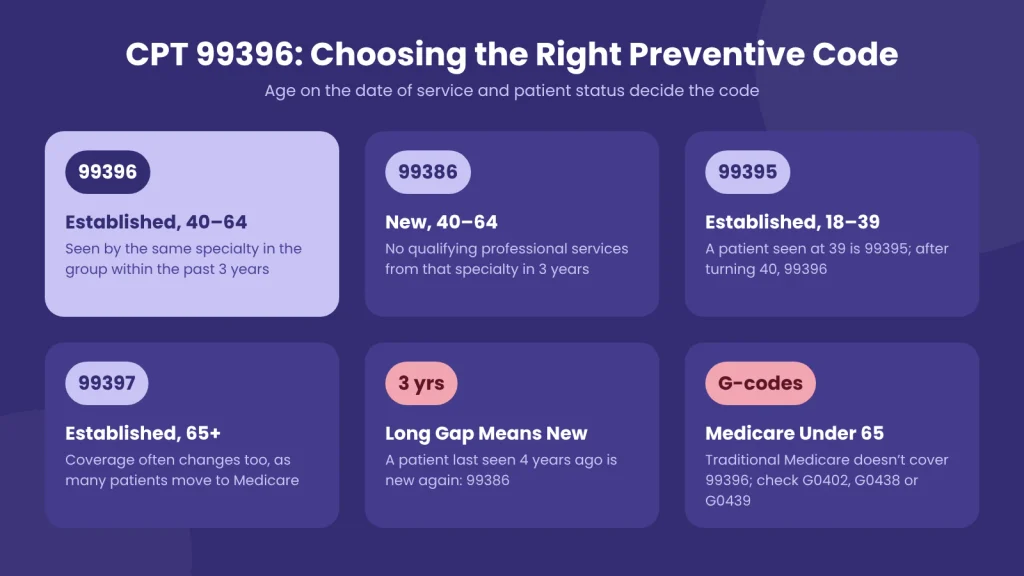
Preventive medicine codes are selected by two factors: the patient’s age and whether the patient is new or established.
| CPT code | Patient status | Age range |
| 99385 | New patient | 18–39 |
| 99386 | New patient | 40–64 |
| 99395 | Established patient | 18–39 |
| 99396 | Established patient | 40–64 |
| 99397 | Established patient | 65 and older |
The table focuses on the codes most relevant to this article. Confirm the current CPT code set and payer requirements before billing.
When Should a Practice Use CPT 99386 Instead of 99396?
Consider two 52-year-old patients scheduled for a physical on the same day:
- Patient A had an office visit with the practice’s family physician 18 months ago. She’s established, so her preventive visit is 99396.
- Patient B was last seen by the same practice five years ago and has had no other qualifying professional services from the same specialty and subspecialty in the group during the past three years. He’s new again, so his preventive visit is 99386.
Same age, same type of visit, different codes. Age narrows the choice to 99386 or 99396. Patient status decides between them. For a full explanation of the new-patient preventive codes in the younger age range, see our CPT 99385 billing guide.
When Does CPT 99395 Apply?
CPT 99395 is generally used for established patients aged 18 through 39. A patient seen at 39 for a physical is 99395. The same patient seen after turning 40 is 99396. The descriptors are parallel. Only the age band changes.
When Does CPT 99397 Apply?
CPT 99397 is generally used for established patients aged 65 and older. At 65, the CPT code category changes. Coverage often changes at the same time, because many patients enroll in Medicare around this age, and traditional Medicare doesn’t pay for routine physicals under the 99381–99397 codes. Review the patient’s coverage separately rather than assuming the CPT code change is the only adjustment needed.
Patients Under 65 With Medicare
Some patients aged 40–64 qualify for Medicare because of disability or other eligibility circumstances. Traditional Medicare does not cover a routine annual physical under CPT 99396, but eligible beneficiaries may qualify for Medicare preventive services such as the Initial Preventive Physical Examination (G0402) or an Annual Wellness Visit (G0438 or G0439), depending on Part B enrollment and prior-service history. These are different services with their own requirements, not substitutes for 99396. Verify eligibility and Medicare billing requirements before submitting the claim.
Is CPT Code 99396 an Annual Physical?
In practice, yes. CPT 99396 is the code most often used for an established patient’s yearly physical between ages 40 and 64. But the CPT code describes a service. It doesn’t guarantee payment once a year.
The CPT descriptor says “periodic,” not “annual.” How often a preventive visit is covered is decided by the patient’s plan. Commercial plans, Medicare Advantage plans, Medicaid programs and self-funded employer plans can all apply different frequency limits and benefit rules.
Many non-grandfathered health plans must cover specified recommended preventive services without cost-sharing when applicable requirements are met, including in-network care. Some plans also cover a comprehensive preventive office visit at no cost under their benefit terms. However, ACA protections do not automatically make every service performed during a physical free. Diagnostic services, unrelated problem-oriented care and services outside the plan’s preventive coverage rules may still involve cost-sharing. Grandfathered plans, short-term plans and out-of-network visits may also be subject to different coverage and cost-sharing rules.
Best practice: Verify the patient’s preventive benefit and the plan’s frequency rule before the appointment, not after the claim comes back.
How Often Can CPT 99396 Be Billed?

There’s no single answer, because frequency is set by the payer. Common patterns include:
| Frequency rule | How it works | Example |
| Once per calendar year | One preventive visit between January 1 and December 31 | A visit on March 10, 2026 and another on January 15, 2027 are both allowed |
| Once every 12 months (rolling) | The next visit must be at least 12 months after the last one | A visit on March 10, 2026 means the next can’t be before March 10, 2027 |
| Once per plan year | Tied to the plan’s benefit year, which may not match the calendar | A plan year starting July 1 resets on that date |
Some payers also apply their own specific day-count intervals. Check the plan’s exact wording rather than assuming one of the patterns above.
Rolling 12-month rules cause the most avoidable denials. A patient whose physical was on April 20 last year and who booked April 5 this year may have the claim denied for frequency, even though it’s “this year’s physical.”
Before scheduling, check:
- The date of the last preventive service, including services billed by other practices if the payer’s portal shows them
- The plan’s frequency rule
- Whether the patient changed plans, since a new plan may have a different benefit year
Preventive Screening Add-On Codes and Services With CPT 99396
CPT 99396 reports the comprehensive preventive E/M service. Additional screenings, tests and procedures may be separately reportable when they’re actually performed, appropriate for the patient, documented and allowed under the payer’s policy.
“Add-on” is used loosely here. In CPT, an add-on code is a specific type of code that can only be reported with a primary code. The services below aren’t CPT add-on codes to 99396. They’re separate services that are often performed during the same visit.
Common Screening Services During a Preventive Visit
For patients aged 40–64, the U.S. Preventive Services Task Force (USPSTF) recommends several screenings based on age and risk. Recommendations rated A or B are typically covered without cost-sharing by plans that must follow ACA preventive rules.
| Screening | Who it generally applies to (USPSTF) |
| Breast cancer screening (mammography) | Women and other people assigned female at birth aged 40–74, every 2 years |
| Colorectal cancer screening | Adults aged 45–75 |
| Cervical cancer screening | Women aged 21–65, at intervals based on the test used |
| Prediabetes and type 2 diabetes screening | Asymptomatic adults aged 35–70 with overweight or obesity |
| Statin use for primary prevention of cardiovascular disease | Adults aged 40–75 with at least one cardiovascular risk factor. The recommendation depends on estimated 10-year cardiovascular risk: statins are recommended at 10% or higher and may be offered to selected patients between 7.5% and 10% |
| Lung cancer screening | Adults aged 50–80 with a 20 pack-year smoking history who smoke now or quit within 15 years |
| Osteoporosis screening | Postmenopausal women under 65 at increased risk |
| Depression screening | All adults |
| HIV screening | Generally ages 15–65, with risk-based screening outside that range |
| Hepatitis C screening | Generally ages 18–79, with risk-based considerations outside that range |
| Prostate cancer screening | Men aged 55–69, as an individual decision with the provider |
USPSTF recommendations change over time. Check the current recommendation and the payer’s preventive coverage list before relying on these ranges.
Most of these screenings are performed outside the office visit, by a lab, an imaging center or a gastroenterologist. The primary care practice usually orders them and bills only for what it performs in-house.
Commonly Relevant Screening and Preventive Codes

The codes below often come up alongside a 99396 visit. None of them is automatically separately payable with 99396. Each depends on the service actually performed, code-specific rules, NCCI bundling edits, medical necessity where it applies and payer policy.
| Code | Service area | Billing consideration |
| 96127 | Brief emotional or behavioral assessment, such as a depression questionnaire | Report only when a standardized instrument is scored and documented and the payer’s policy allows it with a preventive visit |
| 96160 | Patient-focused health risk assessment instrument | Confirm the instrument, scoring, documentation and payer coverage before reporting |
| 99401–99404 | Preventive medicine counseling and risk factor reduction | Not reported for counseling given as part of the 99396 visit. These codes describe counseling at a separate encounter |
| 36415 | Routine venipuncture | Report only when the practice draws the blood and the payer pays for it separately. Some payers bundle it |
| 82270 | Fecal occult blood test (guaiac), for colorectal screening | Report when the practice performs the test, typically after the patient returns the cards, and the payer covers it |
| Q0091 | Screening Pap smear specimen collection (Medicare) | Commercial payers may use different codes or include collection in the visit |
| 90471 + vaccine product code | Immunization administration and the vaccine | Report when the vaccine is administered. Some payer policies may require modifier 25 on CPT 99396 to identify the separately reportable preventive visit when vaccine administration is also billed. Check the payer’s current billing instructions and applicable NCCI edits. Link the vaccine product and administration to Z23. |
| 93000 | Electrocardiogram with interpretation | Routine screening ECGs often aren’t covered for asymptomatic adults. Verify coverage and the documented reason |
| 80050 | General health panel | Report only when every component of the panel is performed. Many payers don’t cover it as a routine screening |
Two different uses of modifier 25. In the vaccine row above, modifier 25 may go on 99396 itself, to show the preventive visit is separate from the vaccine administration. That’s a different situation from a same-day problem-oriented visit, where modifier 25 goes on the problem-oriented E/M code. Follow each payer’s instructions for which code carries the modifier.
Common mistakes with these codes:
- Billing 99401 for the diet and exercise talk that’s already part of 99396
- Billing 80050 when only some of its components were run
- Billing a screening ECG to a plan that doesn’t cover it, without informing the patient first
- Billing 96127 without a scored, documented instrument
- Assuming a code is payable because it’s listed in a coding reference
Visual acuity checks and similar simple screening steps done during the exam are generally considered part of the preventive service and often aren’t separately reimbursed.
Using Modifier 33 for Preventive Services
Modifier 33 can help identify a separately reported service as preventive when it meets applicable evidence-based preventive service requirements. Some commercial payers use it to process preventive benefits, particularly for services that may otherwise appear diagnostic or therapeutic. However, modifier 33 does not guarantee zero cost-sharing. Coverage depends on the patient’s plan, eligibility, network status and payer-specific claim instructions. Some payers don’t use the modifier in their benefit decisions at all.
Modifier 33 matters most for services that aren’t obviously preventive from the code alone, such as a colonoscopy that started as a screening. It isn’t usually needed on codes like 99396 that are inherently preventive.
Medicare uses different modifiers for colorectal screening:
- KX is used for a follow-up screening colonoscopy after a qualifying positive stool-based screening test.
- PT identifies a colorectal cancer screening procedure that became diagnostic or therapeutic, such as when a polyp is removed.
Follow Medicare’s specific instructions for Medicare patients.
Preventive Screening vs. Diagnostic Testing
The same test can be screening or diagnostic, and the difference changes the diagnosis code, the coverage and often the patient’s bill.
| Screening | Diagnostic | |
| Patient | Has no symptoms related to the test | Has symptoms, abnormal findings or a known condition |
| Purpose | Look for disease that hasn’t shown up yet | Evaluate a specific problem or monitor a condition |
| Typical diagnosis | A Z12–Z13 screening code | The symptom or condition code |
| Typical coverage | Preventive benefit, often no cost-sharing | Regular medical benefit, with deductible or coinsurance |
Examples:
- A 50-year-old with no symptoms and a mammogram due: screening, with Z12.31.
- A 50-year-old who reports a breast lump: diagnostic, with the code for the documented finding.
- A 58-year-old with known type 2 diabetes getting an A1c: monitoring, coded to the diabetes, not to a diabetes screening code.
A screening can also become diagnostic during the procedure. A common example is a screening colonoscopy where a polyp is removed. Federal guidance says plans that must follow ACA preventive rules can’t impose cost-sharing for polyp removal during a screening colonoscopy, or for a follow-up colonoscopy after a positive stool-based screening test. Proper modifiers are often needed for the claim to process that way. Practices that refer patients should make sure the performing provider knows the test began as a screening.
Can a Problem-Oriented E/M Service Be Billed With CPT 99396?
Yes, when it’s significant and separately identifiable. Patients in this age group often bring up a new problem or need active management of a chronic condition during their physical. When the provider does additional work beyond the preventive service to evaluate and manage that problem, a problem-oriented office E/M code may also be reported.
- Modifier 25 is generally appended to the problem-oriented E/M code, not to 99396.
- A minor issue, a stable condition reviewed without changes, or a routine discussion that’s already part of the preventive service doesn’t justify a separate E/M line.
- The documentation should clearly support both services, ideally with the problem-oriented portion in its own section of the note.
- Payer policies vary. Some reduce payment for the problem-oriented visit when billed with a preventive service, and some have specific rules about which E/M codes they’ll accept alongside it.
Example: A 56-year-old established patient comes for his physical. His home blood pressure readings have been rising, so the provider reviews the readings, adjusts his medication, orders a metabolic panel and plans a follow-up. That’s additional, separately identifiable work. The claim could include 99396 and a problem-oriented E/M with modifier 25, linked to the hypertension diagnosis.
If his blood pressure had been stable on his current medication with no changes needed, the review would be part of the preventive visit.
Tell the patient about cost-sharing. The preventive portion may be covered in full, but the problem-oriented visit is usually subject to the patient’s copay, deductible or coinsurance. Patients often don’t expect a bill after a “free” physical, so a brief explanation during the visit prevents complaints later.
ICD-10-CM Diagnosis Codes Used With CPT 99396
Diagnosis selection should reflect the purpose of the encounter and what the provider found. Don’t choose a diagnosis just because it’s commonly paired with physicals.
| ICD-10-CM code | Description | Coding consideration |
| Z00.00 | Encounter for general adult medical examination without abnormal findings | The exam is documented with no abnormal findings |
| Z00.01 | Encounter for general adult medical examination with abnormal findings | Abnormal findings are identified and documented, with additional codes for the findings |
| Z12.11 | Encounter for screening for malignant neoplasm of colon | Colorectal cancer screening is performed or ordered |
| Z12.31 | Encounter for screening mammogram for malignant neoplasm of breast | Screening mammography is ordered or performed |
| Z12.4 | Encounter for screening for malignant neoplasm of cervix | Cervical cancer screening is performed |
| Z13.1 | Encounter for screening for diabetes mellitus | Diabetes screening is the documented purpose |
| Z13.220 | Encounter for screening for lipoid disorders | Lipid screening is performed in a patient without a known lipid disorder |
| Z13.31 | Encounter for screening for depression | A depression screening is performed |
| Z23 | Encounter for immunization | A vaccine is administered |
Z00.00 vs. Z00.01: Which Diagnosis Should Be Used?
The choice depends on whether the provider documents an abnormal finding during the exam.
- Z00.00 fits an exam with no abnormal findings.
- Z00.01 fits an exam where the provider identifies something abnormal, such as a newly detected heart murmur or an elevated blood pressure reading that the provider evaluates. Z00.01 comes with an instruction to use additional codes to identify the abnormal findings.
The finding must be documented by the provider and appropriately evaluated. Coders shouldn’t assign Z00.01 based on the problem list alone. A known, stable chronic condition that’s simply noted doesn’t necessarily make the exam “abnormal” for this purpose. The provider’s documentation of the current encounter decides.
How to Link Diagnosis Codes to Preventive and Additional Services
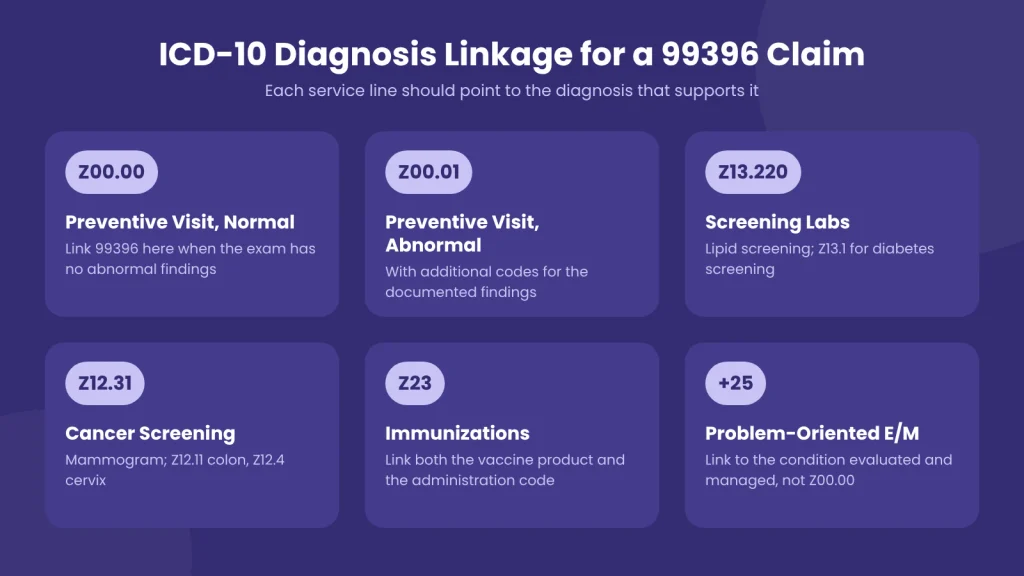
On a claim, each service line points to the diagnosis that supports it. Getting these pointers right helps the payer apply the correct benefit to each line.
| Service on the claim | Linked diagnosis |
| 99396 | Z00.00 or Z00.01 |
| Screening lab, such as a lipid panel | The matching screening code, such as Z13.220 |
| Problem-oriented E/M with modifier 25 | The condition that was evaluated and managed |
| Diagnostic test for a symptom | The symptom or condition code |
| Vaccine product and administration | Z23 |
A common error is linking every line to Z00.00. That can cause a diagnostic test to be processed as preventive, or a problem-oriented visit to be denied because nothing on the claim explains why it was needed. Follow each payer’s instructions for diagnosis pointers.
Symptoms raised during a physical need their own codes, too. Our guide to the ICD-10 code for fatigue shows how symptom codes are selected when a patient brings up a complaint.
Documentation Requirements for CPT 99396
The record should support the comprehensive preventive service that was actually performed, plus any separately billed service.
Essential Documentation Checklist
- Patient’s age on the date of service and established-patient status
- Interval medical, family and social history
- Medication and allergy review
- Preventive risk assessment appropriate for age and sex
- A description of the age- and risk-appropriate examination performed
- Counseling and anticipatory guidance, with the topics covered
- Screening recommendations, orders and any screenings declined by the patient
- Abnormal findings and the follow-up plan for each
- Separate documentation for any problem-oriented E/M service billed with modifier 25
Documentation for Screening Add-Ons
For each separately billed screening or test:
- Record the specific screening or procedure performed
- Include the result, score, interpretation or follow-up plan when the code requires it
- Make sure the diagnosis supports the screening or diagnostic purpose
- Keep supporting documentation, such as the completed questionnaire for 96127 or the scored instrument for 96160
Documentation Mistakes That Can Trigger Denials
- Missing interval history, or an exam description that doesn’t show what was actually evaluated
- Separately billed services with no documentation in the note
- Diagnosis codes that don’t match the documented service
- A problem-oriented E/M billed with modifier 25 but no separate documentation of the problem work
- Incomplete documentation of screening tests, such as an unscored questionnaire
A routine medical billing audit of preventive visits often finds these issues before payers do.
How to Bill CPT Code 99396: Step-by-Step Workflow
- Verify patient eligibility. Confirm active coverage, the preventive benefit, the plan’s frequency rule and the date of the last preventive service.
- Confirm patient status. Apply the three-year rule for the same specialty and subspecialty in the group.
- Confirm the age category. Check the patient’s age on the date of service, especially near birthdays at 40 and 65.
- Review provider documentation. Make sure the note supports a comprehensive preventive service.
- Select the preventive diagnosis. Choose Z00.00 or Z00.01 based on documented findings, plus codes for any abnormal findings.
- Review additional services. Identify screenings, tests, vaccines and procedures that were actually performed and may be separately reportable.
- Apply modifiers when appropriate. Review modifier 25 for a separate problem-oriented E/M or where a payer requires it on 99396 with vaccine administration, and modifier 33 or Medicare modifiers where the payer requires them.
- Check coding edits. Review NCCI edits, payer bundling rules and claim-specific requirements, including diagnosis pointers.
- Submit and monitor the claim. Track acceptance, payment, rejections and denials, and act on problems quickly.
Our medical coding services team supports steps 4 through 8, and our accounts receivable management team handles follow-up in step 9.
Common CPT 99396 Billing Errors and How to Prevent Them
| Common error | Why it causes problems | Prevention strategy |
| Billing 99396 for a new patient | Wrong code for patient status | Apply the three-year rule before coding |
| Using 99396 outside the age range | Code doesn’t match the patient’s age | Check age on the date of service |
| Assuming every preventive visit is covered annually | Plan frequency limits differ | Verify benefits and the last preventive date before the visit |
| Billing 99401–99404 for counseling within the physical | Counseling is already part of 99396 | Report preventive counseling codes only for separate encounters |
| Reporting screening services without support | Code requirements or documentation not met | Confirm the service was performed, documented and covered |
| Incorrect modifier 25 use | Separate E/M not supported or modifier on the wrong code | Follow payer rules on which code carries the modifier |
| Linking every service to Z00.00 | Diagnostic and problem services lose their support | Link each line to its own supporting diagnosis |
| Overlooking payer edits | Claim lines bundled or denied | Check NCCI edits and payer policies |
| Billing 99396 to traditional Medicare | Traditional Medicare doesn’t cover routine physicals | Check eligibility for Medicare’s own preventive services and their requirements |
CPT 99396 Denials: Common Reasons and Resolution Tips
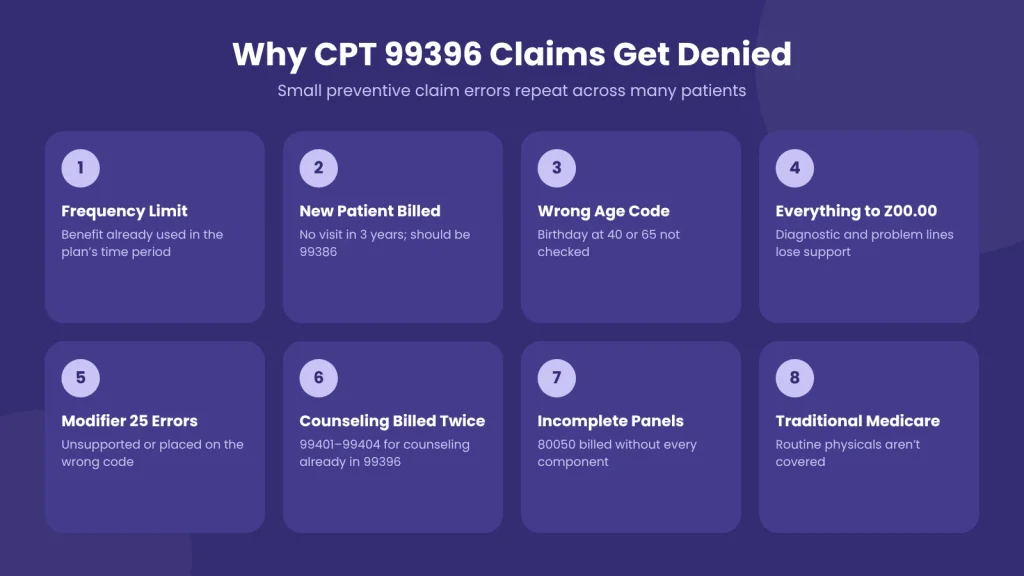
Denials on preventive claims are usually small individually, but they repeat across many patients. Knowing the common patterns makes them easier to fix and prevent. Denial reason codes vary by payer. The examples below describe typical scenarios.
Preventive Service Frequency Denials
These often appear with a reason such as “benefit maximum for this time period has been reached.”
- Check the date of the previous preventive service, including services billed by other providers.
- Review the payer’s calendar-year, plan-year or rolling-period frequency rule.
- If the denial conflicts with the member’s actual benefits, correct the claim or appeal with the benefit details.
- If the visit truly was too early, review whether the patient was informed in advance and what the plan allows for patient billing.
Patient Status or Age-Related Denials
These often appear when the procedure code doesn’t match the patient’s age or claim history.
- Recheck the patient’s age on the date of service.
- Review prior professional services within the group and specialty over the past three years.
- If the original code was wrong, submit a corrected claim with 99386, 99395 or 99397 as appropriate.
Duplicate Claim Denials
- Check whether another claim was already submitted for the same preventive service.
- Confirm whether the earlier claim was paid, rejected or is still pending.
- Use the payer’s corrected-claim or replacement-claim process instead of resubmitting a new original claim.
Modifier 25 and Separate E/M Denials
- Review whether the problem-oriented service was truly significant and separately identifiable.
- Confirm modifier 25 is on the code the payer requires.
- When appealing, send documentation that clearly separates the problem work from the preventive service.
Screening and Diagnosis-Related Denials
- Check whether the linked diagnosis supports the screening or test.
- Review preventive coverage and frequency limits for the specific screening.
- Confirm the code matches the service performed, such as all components of a panel.
- For screening procedures that became diagnostic, confirm the required modifiers were used.
Tracking denials by reason over several months shows which steps in the workflow need attention. A structured denial management process turns those patterns into fixes at the front end.
How Medical Billing Services Help Practices Improve CPT 99396 Reimbursement
Preventive visits for patients aged 40–64 combine several billing risks in one encounter: age and status rules, frequency limits, separately reportable screenings, same-day problem visits and diagnosis linkage. Each is manageable on its own. Handling all of them consistently across every provider and every visit is where practices lose revenue.
Preventive Visit Coding and Claim Accuracy
- Verify patient status and age-based code selection
- Review preventive and problem-oriented services separately
- Check diagnosis linkage, modifiers and payer edits before submission
Eligibility Verification and Benefit Checks
- Confirm preventive benefits before the visit
- Identify frequency limits and the date of the last preventive service
- Flag potential patient cost-sharing so staff can explain it in advance
Denial Management and A/R Follow-Up
- Identify recurring CPT 99396 denial patterns
- Correct coding or documentation issues at the source
- Track unpaid claims and follow up with payers until they’re resolved
Why Practices Outsource Medical Billing
- Reduce the administrative workload on front-desk and billing staff
- Apply claim review and follow-up consistently
- Give practice staff more time for patient care and operations
iSolve RCM supports these steps through our outsourced medical billing services and full revenue cycle management. Primary care practices handle the most preventive visits, and our guide to family practice billing and claim denials covers related issues. Practices that screen for diabetes and manage metabolic conditions may also find our endocrinology billing services useful, and depression screening workflows connect to our mental health billing resources.
If you’re weighing your options, our comparison of in-house vs. outsourced medical billing explains the trade-offs, and you can review our pricing. Medicare payment changes for 2027 are covered in our CMS 2027 Physician Fee Schedule guide.
Final Thoughts on CPT Code 99396
The 99396 CPT code is the standard code for an established patient’s preventive visit between ages 40 and 64, but billing it well takes more than picking the code:
- Patient status and age decide the code. Established patients aged 40–64 get 99396. New patients get 99386.
- Annual physical coverage and frequency depend on the patient’s plan, not the CPT descriptor.
- Screenings and tests performed during the visit may be reported separately, but only when they meet code requirements, payer rules and documentation standards.
- Modifiers need care: modifier 25 may belong on the problem-oriented E/M or, under some payer rules, on 99396 with vaccine administration, and modifier 33 doesn’t guarantee zero cost-sharing.
- Eligibility checks, claim edits and denial follow-up prevent most of the avoidable problems on these claims.
If preventive visit denials, frequency rejections or coding questions are slowing your practice down, an experienced billing partner can help you review and tighten the workflow.
Frequently Asked Questions About CPT Code 99396
What is CPT code 99396?
CPT 99396 is a periodic comprehensive preventive medicine reevaluation and management service for an established patient aged 40 through 64. It covers an age- and gender-appropriate history and exam, counseling, risk-factor reduction and ordering of appropriate tests, and is commonly used for a routine physical.
What is the age limit for CPT 99396?
CPT 99396 applies to established patients aged 40 through 64 on the date of service. An established patient aged 39 uses 99395, and an established patient who has turned 65 uses 99397.
Is CPT 99396 for new or established patients?
CPT 99396 is for established patients. A patient is established if they’ve received professional services from the same provider, or another provider of the same specialty and subspecialty in the group, within three years. New patients aged 40–64 are generally reported with 99386.
Is CPT 99396 an annual physical?
It’s commonly used for an established patient’s yearly physical between 40 and 64. However, the CPT code doesn’t set the payment frequency. How often a preventive visit is covered, and whether the patient owes anything, depends on the patient’s plan and the payer’s policy.
What is the difference between CPT 99396 and 99395?
Both are periodic preventive visits for established patients. CPT 99395 applies to ages 18 through 39, and CPT 99396 applies to ages 40 through 64. The patient’s age on the date of service decides which one to use.
What is the difference between CPT 99396 and 99397?
CPT 99396 applies to established patients aged 40 through 64, and CPT 99397 applies to established patients aged 65 and older. At 65, coverage often changes as well, because traditional Medicare doesn’t cover routine physicals and has its own preventive services with separate requirements.
Can CPT 99396 be billed with a problem-oriented office visit?
Yes, when the provider performs significant, separately identifiable work to evaluate and manage a problem. Modifier 25 is generally appended to the problem-oriented E/M code. Minor or stable issues that need no extra work don’t support a separate code, and payer policies vary.
Can lab tests and screenings be billed with CPT 99396?
Tests and screenings that are actually performed and documented may be reported separately when code requirements, NCCI edits and payer coverage allow it. They aren’t automatically payable. Routine counseling given during the visit isn’t billed separately with 99401–99404.
What diagnosis code is used with CPT 99396?
CPT 99396 is usually linked to Z00.00 when the exam has no abnormal findings, or Z00.01 when the provider documents and evaluates abnormal findings, with additional codes for those findings. Screening services and vaccines should be linked to their own diagnosis codes.
How often can CPT 99396 be billed?
Frequency is set by the payer’s preventive benefit, not by the CPT code. Plans may allow one visit per calendar year, per plan year or every rolling 12 months, and some use other intervals. Check the plan’s rule and the date of the last preventive service before scheduling.