

On October 1, 2026, the FY 2027 ICD-10-CM code set took effect with 190 new, 30 deleted and 4 revised diagnosis codes, as the Society of Interventional Radiology reported when CMS posted the files on June 5. Most claims in A/R, appeals and payer audits still carry 2026 dates of service. Those claims follow the ICD-10-CM 2026 updates, not the new code set.
The ICD-10-CM 2026 updates came in two releases. The FY 2026 code set started October 1, 2025, and the April 1, 2026 update changed instructional notes without adding a single code. Payers moved in the same window: UnitedHealthcare Medicare Advantage began enforcing Excludes1 edits on inpatient claims February 1, 2026 and on outpatient and professional claims March 1, 2026.
Quick answer: The ICD-10-CM 2026 updates cover dates of service from October 1, 2025 through September 30, 2026. The FY 2026 code set added 487 codes, revised 38 and deleted 28. The April 1, 2026 update added no codes but converted several Excludes1 notes to Excludes2 and changed the I16.1 note to “code also.” Dates of service from October 1, 2026 use the FY 2027 code set.
ICD-10-CM 2026 Update Timeline
The timeline below lists the 2026 ICD-10 news that changed codes or claim edits, in date order.
| Date | Release or Change | What Changes |
|---|---|---|
| October 1, 2025 | FY 2026 code set and guidelines | 487 new, 38 revised and 28 deleted codes; new guidelines for HIV sequencing, multiple sites and type 2 diabetes in remission |
| February 1, 2026 | UnitedHealthcare Medicare Advantage | Excludes1 edit enforcement on inpatient claims |
| March 1, 2026 | UnitedHealthcare Medicare Advantage | Excludes1 enforcement extends to outpatient and professional claims |
| April 1, 2026 | FY 2026 mid-year update | No new, deleted or revised ICD-10-CM codes; Excludes1 notes converted to Excludes2; I16.1 “code also” note; 80 new ICD-10-PCS codes; MS-DRG Grouper v43.1 |
| June 5, 2026 | FY 2027 files released | CMS posts the 2027 ICD-10-CM code files |
| October 1, 2026 | FY 2027 code set and guidelines | 190 new, 30 deleted and 4 revised codes for dates of service through September 30, 2027 |
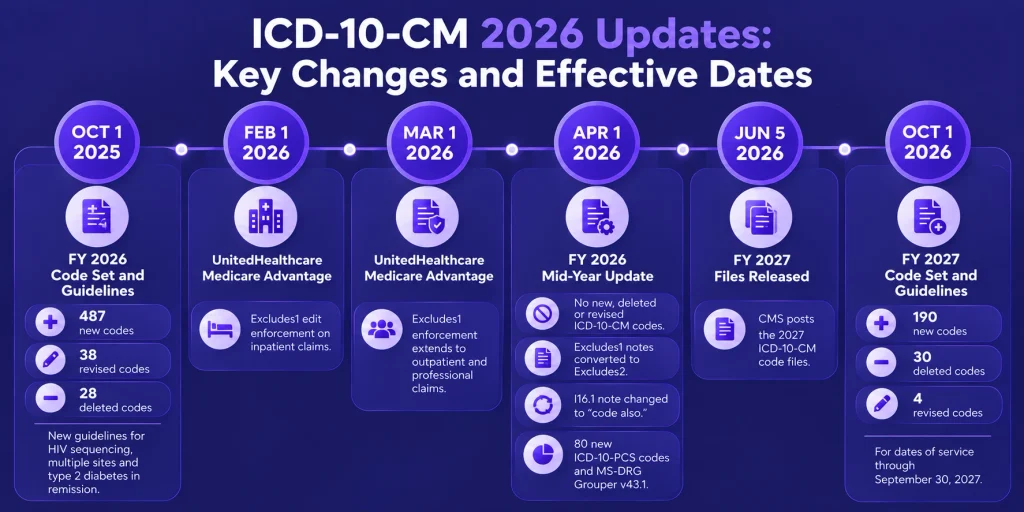
Source: CMS ICD-10 page; AHA Coding Clinic; CMS Transmittal R13490CP; UnitedHealthcare Medicare Advantage Reimbursement Policy Update Bulletin, January 2026; Society of Interventional Radiology.
Each date changes the codes or edits a claim must pass, so coders review every claim against the rules in force on its date of service.

What Changed in the FY 2026 ICD-10-CM Code Set?
The FY 2026 ICD-10-CM code set added 487 codes, revised 38 and deleted 28 for encounters and discharges from October 1, 2025, according to the AHA Coding Clinic. Every one of the 28 deleted codes was split into more specific child codes, so the old code no longer passes claim validation.
The table below lists 10 FY 2026 code families and the documentation each one needs.
| Code Family | What It Reports | What to Document |
|---|---|---|
| E11.A | Type 2 diabetes mellitus without complications, in remission | Provider statement of “remission”; “resolved” does not qualify |
| G35.A to G35.D | Multiple sclerosis by type: relapsing-remitting, primary progressive, secondary progressive or unspecified | MS type and, for progressive forms, active or non-active status |
| C50.A0 to C50.A2 | Malignant inflammatory neoplasm of breast | Inflammatory type and side |
| R10.20 to R10.24; R10.A0 to R10.A3 | Pelvic, perineal, suprapubic and flank pain | Side or exact site |
| R11.16 | Cannabis hyperemesis syndrome | Provider diagnosis of the syndrome |
| T65.84- | Toxic effect of xylazine | Intent and encounter (A, D or S) |
| L98.43- to L98.47-; L98.A- | Non-pressure chronic ulcers of abdomen, chest, neck, face, groin and upper limb | Site, side and severity |
| E78.010 to E78.019 | Familial hypercholesterolemia: homozygous, heterozygous or unspecified | Familial type |
| Z59.861 to Z59.869 | Financial insecurity, including difficulty paying for utilities | Social need from any clinician’s note (Guideline I.B.14) |
| Z91.0110 to Z91.0122 | Milk and egg allergy by baked-food tolerance or reactivity | Tolerance or reactivity to baked milk or egg |
Source: CMS 2026 ICD-10-CM Addendum; FY 2026 ICD-10-CM Official Guidelines for Coding and Reporting.
Each row adds a documentation element, so provider templates need the same update as the code list.
Which FY 2026 Codes Are No Longer Billable?
G35, R10.2, H01.8, E88.1 and E78.01 are among the codes that became parent categories on October 1, 2025, and none of them is valid on a claim. G35 now requires G35.A, G35.B0 to G35.B2, G35.C0 to G35.C2 or G35.D. R10.2 requires R10.20 to R10.24, and H01.8 requires one of nine eyelid inflammation codes from H01.81 to H01.8B. Other pain categories are covered in our guide to ICD-10-CM pain diagnosis codes.
Payer policies follow these splits on their own schedule. Blue Cross & Blue Shield of Rhode Island replaced E88.1 with E88.10 to E88.14 and E88.19 in its lipoprotein testing policy effective April 1, 2026, six months after the code change.
What Changed in the FY 2026 ICD-10-CM Coding Guidelines?
The FY 2026 ICD-10-CM Official Guidelines added rules for multiple sites, HIV sequencing and type 2 diabetes in remission, and they apply to every FY 2026 date of service. Five guideline changes affect daily code assignment:
- Commas in the Alphabetic Index (I.A.7): A comma’s meaning depends on context. It marks alternate wording, a modifier or an “and/or” choice.
- Other clinicians’ notes (I.B.14): Firearm injury intent joins BMI, pressure ulcer stage, social determinants of health and laterality as data a coder can take from a non-provider note.
- Multiple sites (I.B.20): “Multiple” means two or more sites. Coders follow the chapter guideline first, code each documented site separately and use a “multiple sites” code only when the sites are not specified.
- HIV (I.C.1.a): The revised section covers antiretroviral management. A patient with documented HIV disease on antiretrovirals gets B20, and an HIV-positive patient with no HIV disease gets Z21.
- Type 2 diabetes in remission (I.C.4.a.1.b): E11.A requires provider documentation of remission. The guideline states that “resolved” is not the same as remission and tells coders to query when the record is unclear.
These official coding guidelines for 2026 still govern any FY 2026 claim reworked after October 1, 2026.
What Changed in the April 1, 2026 ICD-10-CM Update?
The April 1, 2026 update added, deleted and revised no ICD-10-CM codes. It changed instructional notes in the Tabular List for encounters and discharges from April 1 through September 30, 2026.
The changes sit in the April 1, 2026 Addendum and the April 1, 2026 Code Tables, Tabular and Index ZIP files on the CMS ICD-10 page. CMS sent the update to Medicare contractors in Transmittal R13490CP, with an April 1 effective date and an April 6, 2026 implementation date. Four April 1, 2026 changes affect coding and claim edits:
- Excludes1 to Excludes2 conversions: Several code pairs that were blocked can now be reported together when both conditions are documented. Heartburn (R12) and dyspepsia NOS (R10.13) are one example.
- Hypertensive emergency (I16.1): The “use additional code” note for organ dysfunction became a “code also” note. Under Guideline I.A.17, a “code also” note gives no sequencing direction, so the reason for the encounter decides which code goes first.
- Updated guidelines: CMS and NCHS reissued the FY 2026 Official Guidelines as an April 1, 2026 version for April 1 to September 30, 2026, with narrative changes marked in bold.
- ICD-10-PCS: Hospitals received 80 new procedure codes and 2 deletions, with MS-DRG Grouper version 43.1.
A team that checked only for new codes on April 1 missed every one of these changes.
Why Do Excludes Note Changes Affect Payer Edits?
Excludes notes decide whether a claim edit accepts two diagnosis codes together, and payers enforce those notes in 2026. UnitedHealthcare Medicare Advantage began enforcing Excludes1 rules on inpatient claims February 1, 2026 and extended enforcement to outpatient and professional claims March 1, 2026, according to its January 2026 reimbursement policy bulletin. An edit table that still runs October 2025 notes blocks code pairs that became valid on April 1, 2026.
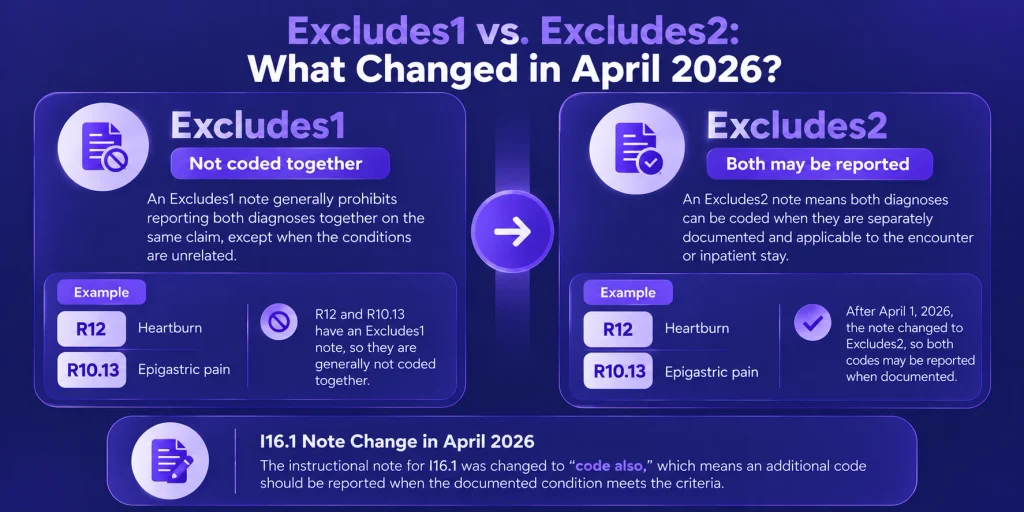
The guidelines also allow two codes under an Excludes1 note when the conditions are unrelated, and they tell coders to query the provider when the link is unclear (Guideline I.A.12.a). A provider statement that the conditions are separate supports the claim when a payer edit flags it.
What Changed in the ICD-10-CM Code Set on October 1, 2026?
The FY 2027 ICD-10-CM code set took effect October 1, 2026 with 190 new, 30 deleted and 4 revised codes, and it applies to encounters and discharges through September 30, 2027, according to the CMS ICD-10 page. The table below lists 12 FY 2027 changes that replace or expand codes used in 2026.
| Code(s) | Description | Replaces or Expands |
|---|---|---|
| I42.00, I42.01, I42.09 | Dilated cardiomyopathy: unspecified, familial-genetic or other | I42.0, now a parent code |
| I42.81, I42.89 | Arrhythmogenic cardiomyopathy; other cardiomyopathies | I42.8, now a parent code |
| I49.81, I49.82, I49.89 | Brugada syndrome; ventricular bigeminy; other specified arrhythmias | I49.8, now a parent code |
| I47.22 | Catecholaminergic polymorphic ventricular tachycardia | New code |
| M04.3 | VEXAS syndrome | New code |
| M67.A01, M67.A02, M67.A09 | Plantar fasciitis of right, left or unspecified foot | New subcategory |
| M72.20 to M72.22 | Plantar fascial fibromatosis by foot | M72.2, now a parent code |
| J34.830 to J34.839 | Odontogenic sinusitis by sinus | New subcategory |
| QA1.71; QA1.790 to QA1.792 | Lynch syndrome; BRCA1 and BRCA2 cancer syndromes; Li-Fraumeni syndrome | New category QA1 |
| Z68.18, Z68.19 | Adult BMI 18.4 or less; adult BMI 18.5 to 19.9 | Z68.1, now a parent code |
| E89.830, E89.838 | Post bariatric hypoglycemia; other postprocedural hypoglycemia | New subcategory |
| O00.3-, O00.4-, O00.5-; O31.4- | Cesarean scar, cervical and cornual ectopic pregnancy; continuing pregnancy after vanishing twin syndrome | New subcategories |
Source: CMS 2027 ICD-10-CM code files; Society of Interventional Radiology.
The FY 2027 Official Guidelines govern these codes for dates of service from October 1, 2026. Plantar fasciitis shows the pattern: M72.2 stopped being billable, and M67.A01, M67.A02 and M67.A09 now carry the laterality, as our plantar fasciitis ICD-10 code guide explains.
Which Codes Stopped Being Billable on October 1, 2026?
Thirty codes stopped being billable on October 1, 2026. Eight codes and code groups became parent categories: D69.1, I42.0, I42.8, I49.8, M72.2, M86.8X1 to M86.8X8, Z68.1 and Z87.890.
The sternoclavicular sprain codes S23.420A, S23.420D and S23.420S and the T52.8X- organic solvent codes were deleted, and T52.81-, T52.82- and T52.89- now report solvent toxicity.
Which ICD-10-CM Code Set Applies to a 2026 Claim?
The date of service decides the code set for outpatient claims, and the discharge date decides it for inpatient claims. The date the claim is sent does not change the code set. Use the table below to match each date range to its code files and guidelines.
| Date of Service or Discharge | Code Set | Guidelines File |
|---|---|---|
| October 1, 2025 to March 31, 2026 | FY 2026, October 2025 release (2026 Code Tables, Tabular and Index) | FY 2026 ICD-10-CM Official Guidelines |
| April 1 to September 30, 2026 | FY 2026 with the April 1, 2026 update | FY 2026 Official Guidelines, updated April 1, 2026 |
| October 1, 2026 to September 30, 2027 | FY 2027 | FY 2027 ICD-10-CM Official Guidelines |
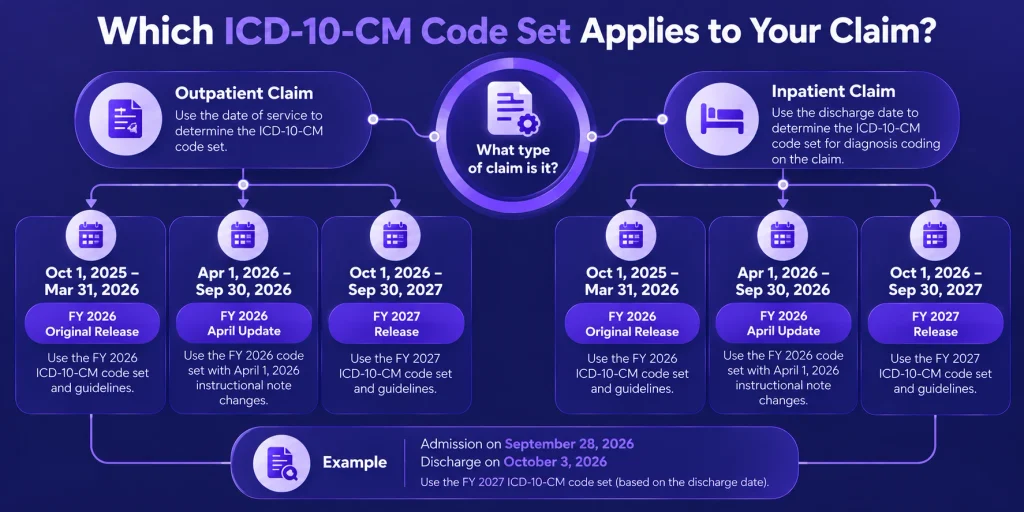
Source: CMS ICD-10 page.
An inpatient stay admitted September 28, 2026 and discharged October 3, 2026 uses FY 2027 codes, because the discharge date falls in FY 2027.
Pro Tip: Keep the FY 2026 code tables active in the claim scrubber for corrected claims, appeals and late charges. M04.3 for VEXAS syndrome is valid on an October 1, 2026 visit and invalid on a September 30, 2026 visit, so the edit has to check the date of service, not the claim date.
Which Instructional Notes Should Coders Re-Check in 2026?
Coders should re-check five instructional notes in 2026: D63.0, E89.1, I5A, T45.A- and G35. Each one controls code order or code choice across two chapters, and the order is easy to reverse from memory. The table below shows each Tabular List note and the code order it requires.
| Code | Tabular List Note | Correct Order |
|---|---|---|
| D63.0 Anemia in neoplastic disease | Code first neoplasm (C00-D49); Excludes2 D64.81 | Neoplasm, then D63.0, even when the encounter treats only the anemia (Guideline I.C.2.c.1) |
| E89.1 Postprocedural hypoinsulinemia | Code first, if applicable, E13.-; use additional Z90.41- and Z79.4 | E13.-, then E89.1, Z90.41- and Z79.4 when the patient uses insulin |
| I5A Non-ischemic myocardial injury | Code first the underlying cause, such as N17.-, I40.-, I42.-, N18.- or I50.- | Underlying cause, then I5A; I21.- and S26.- are Excludes1 |
| T45.AX5- Adverse effect of immune checkpoint inhibitors | Pembrolizumab, a PD-1 inhibitor, classifies to T45.A- | Documented reaction, then T45.AX5A, T45.AX5D or T45.AX5S (Guideline I.C.19.e) |
| G35.A Relapsing-remitting multiple sclerosis | G35 is a parent code since October 1, 2025 | G35.A, plus Z79.620 when the provider documents long-term use of an immunosuppressive biologic |
Source: FY 2026 ICD-10-CM Tabular List; FY 2026 ICD-10-CM Official Guidelines, April 1, 2026 version.
Older cheat sheets still list E89.1 first for postpancreatectomy diabetes, because the order reversed on April 1, 2024. Anemia types outside D63.0 are listed in our ICD-10 code for anemia guide.
What Should Practices Update After Each ICD-10-CM Release?
Practices should update six items after every ICD-10-CM release: code files, pick lists, scrubber edits, provider templates, test claims and denial reports.
- Load the release files by date. Load the CMS code tables and addendum into the EHR, practice management system and encoder, and keep prior versions active for older dates of service.
- Remove parent codes from pick lists. Replace G35, R10.2, I42.0, I49.8 and Z68.1 in favorites, superbills and order sets with their child codes.
- Update scrubber edit tables. Load the Excludes1 and Excludes2 notes from the April 1, 2026 Tabular List into your claim scrubbing rules, then add payer rules such as UnitedHealthcare’s Excludes1 edits.
- Update provider templates. Add prompts for MS type, laterality, remission status and adult BMI range.
- Run test claims on both sides of October 1. Send one September 2026 and one October 2026 date of service through the clearinghouse before live billing.
- Track diagnosis denials by code set. Group diagnosis denials by date of service to find a scrubber or pick list that missed a release.
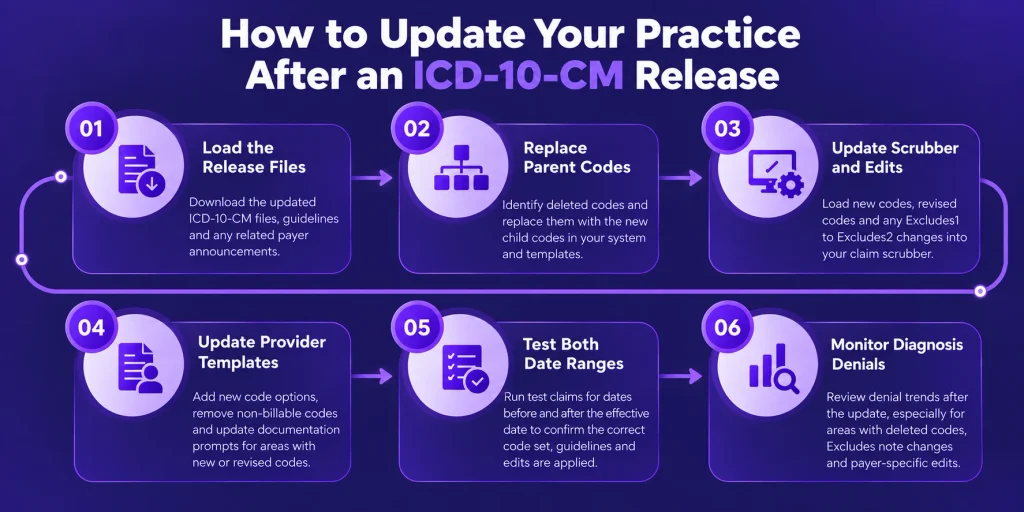
Repeating these six steps before each April 1 and October 1 keeps every claim matched to its code set. CPT codes change on a separate January 1 cycle, covered in our guide to CPT 2026 changes.
What Are the Most Common ICD-10-CM 2026 Coding Errors?
The table below lists seven errors tied to the ICD-10 2026 changes, what each one causes and how to fix it.
| Error | What Happens | Fix |
|---|---|---|
| Parent code billed, such as G35, R10.2, I42.0 or Z68.1 | Claim rejects for an invalid diagnosis | Report the child code that matches the documentation |
| FY 2027 code on a 2026 date of service, such as M04.3 on September 30, 2026 | Claim denies as invalid for the date of service | Match the code set to the date of service or discharge |
| Edit table not updated for April 1, 2026, such as R12 with R10.13 | Scrubber blocks a valid code pair | Load the April 1, 2026 Tabular List notes |
| I16.1 sequenced first by habit | Wrong principal diagnosis and a possible DRG change | Sequence by the reason for the encounter under the “code also” note |
| E89.1 listed before E13.- for postpancreatectomy diabetes | Sequencing finding on audit | Report E13.- first, then E89.1, Z90.41- and Z79.4 |
| E11.A reported when the note says “resolved” | Unsupported code on audit | Query the provider; only “remission” supports E11.A |
| Unrelated conditions under an Excludes1 note with no supporting note | Payer Excludes1 denial | Document that the conditions are unrelated or query the provider |
These denials often return as CARC 146 (diagnosis invalid for the date of service), CARC 16 (claim lacks information or has a billing error) or CARC 11 (diagnosis inconsistent with the procedure), explained in our guide to common denial codes in medical billing.
How Can iSolve RCM Help With ICD-10-CM Updates?
iSolve RCM updates diagnosis code mappings every April 1 and October 1, so each claim carries the ICD-10-CM code set that matches its date of service. Our certified medical coding team reviews remission status, laterality, MS type and sequencing notes before claims go out, and our medical billing audit catches code set and Excludes1 errors before payers do. When a diagnosis denial still comes back, our denial management team corrects and resubmits the claim. Services start at 2.99% of monthly collections.

Frequently Asked Questions
What are the ICD-10-CM 2026 updates?
The ICD-10-CM 2026 updates are the FY 2026 code set effective October 1, 2025 and its April 1, 2026 update. FY 2026 added 487 codes, revised 38 and deleted 28, and the April update changed instructional notes only.
Were new ICD-10-CM codes added on April 1, 2026?
No. The April 1, 2026 update added, deleted and revised no ICD-10-CM codes. It converted several Excludes1 notes to Excludes2 and changed the I16.1 note to “code also.”
Where can I download the 2026 ICD-10-CM code tables and guidelines?
The CMS ICD-10 page hosts the 2026 Code Tables, Tabular and Index ZIP, the April 1, 2026 Code Tables, Tabular and Index ZIP and the FY 2026 guidelines PDF. CDC’s NCHS posts the April 1, 2026 guidelines PDF in its 2026 update folder.
When do the 2026 ICD-10-CM codes stop applying?
FY 2026 codes apply to dates of service and discharges through September 30, 2026. The FY 2027 code set applies from October 1, 2026.
Is G35 still a billable ICD-10-CM code?
No. Since October 1, 2025, G35 is a parent code, and claims need G35.A, G35.B0 to G35.B2, G35.C0 to G35.C2 or G35.D.
What is the ICD-10-CM code for VEXAS syndrome?
M04.3 reports VEXAS syndrome for dates of service from October 1, 2026. The code is new in FY 2027 and is not valid on earlier 2026 dates of service.
What is the ICD-10-CM code for calciphylaxis in 2026?
Calciphylaxis indexes to E83.59, Other disorders of calcium metabolism, in both the FY 2026 and FY 2027 code sets.
How do you code an adverse effect of pembrolizumab?
Code the documented reaction first, then T45.AX5- for the adverse effect of immune checkpoint inhibitors, with A, D or S as the 7th character.