The Medicare Drug Price Negotiation Program now has a permanent rulebook. On November 5, 2026, the Centers for Medicare & Medicaid Services (CMS) issued a final rule that sets how the program will work for 2029 and every year after it.
For practices that buy and administer drugs, this is more than pharmaceutical policy. The 2029 Medicare drug price negotiations can include physician-administered Part B drugs. When one of those drugs gets a negotiated price, the amount Medicare pays the practice for it can change too.
This guide explains these CMS Medicare drug price changes and focuses on what they mean for Part B drug reimbursement, medical billing and healthcare revenue cycle management.
Key Takeaways
- What CMS finalized: A regulation (CMS-4215-F) that codifies the negotiation program for initial price applicability year (IPAY) 2029 and beyond. Up to 20 Part B and/or Part D drugs can be selected for 2029, and previously negotiated drugs can be renegotiated when they meet the criteria.
- When 2029 prices take effect: January 1, 2029. The prices aren’t known yet. CMS publishes the selected drug list by February 1, 2027 and the negotiated prices by November 30, 2027.
- Why Part B providers should review billing workflows: For selected Part B drugs, Medicare’s payment limit is based on the negotiated price instead of average sales price. Accurate coding, units, documentation and payment reconciliation by drug will matter more.
What Is the Medicare Drug Price Negotiation Program?
Understanding the Medicare Prescription Drug Price Negotiation Program
The program allows Medicare to negotiate directly with drug manufacturers over the price of certain medicines. Its legal basis is sections 11001 and 11002 of the Inflation Reduction Act of 2022.
Negotiation is limited to a specific kind of product. CMS negotiates for high-expenditure, single-source drugs and biologics, meaning brand-name products that account for large Medicare spending and don’t yet face generic or biosimilar competition.
The program has been phased in by “initial price applicability year,” or IPAY. That’s the first year a negotiated price applies:
| Cycle | IPAY | What it covered |
| First | 2026 | Part D drugs only |
| Second | 2027 | Part D drugs only |
| Third | 2028 | Part D drugs and, for the first time, Part B drugs |
| Fourth | 2029 | Up to 20 Part B and/or Part D drugs, plus possible renegotiations |
What Is the Medicare Maximum Fair Price (MFP)?
The Medicare maximum fair price (MFP) is the price CMS and a manufacturer agree on for a selected drug. Once it’s in effect, the manufacturer must make that price available for Medicare beneficiaries who use the drug, and to the pharmacies and providers that dispense or administer it to them.
CMS reaches the MFP through a structured exchange. The fact sheet describes an initial written offer with a justification, a manufacturer counteroffer, optional negotiation meetings, further price exchanges and a final offer when needed. After the first year, the MFP is updated annually for inflation.
The MFP is easy to confuse with other drug prices. They aren’t the same:
| Term | What it means |
| List price / wholesale acquisition cost (WAC) | The manufacturer’s published price to wholesalers, before discounts |
| Average sales price (ASP) | The average net price manufacturers receive, used to set most Part B drug payments |
| Provider acquisition cost | What your practice actually pays to buy the drug |
| Maximum fair price (MFP) | The negotiated Medicare price for a selected drug |
A practice’s acquisition cost can be above or below any of these figures. That gap is where the financial risk sits.
Can Medicare Negotiate Drug Prices?
Yes. The Inflation Reduction Act gave CMS the authority to negotiate prices for a limited number of high-spending, single-source drugs each year. It can’t negotiate the price of every drug. A product has to meet the statutory criteria and be selected by CMS.
Selected drugs can come from either part of Medicare:
- Part B covers drugs that are usually administered by a clinician, such as infusions and injections given in an office, clinic or hospital outpatient department.
- Part D covers outpatient prescription drugs that patients usually pick up at a pharmacy.
CMS 2029 Drug Negotiation Rules: What Changed in the Final Rule?
CMS Issues Final Rule for IPAY 2029 and Beyond
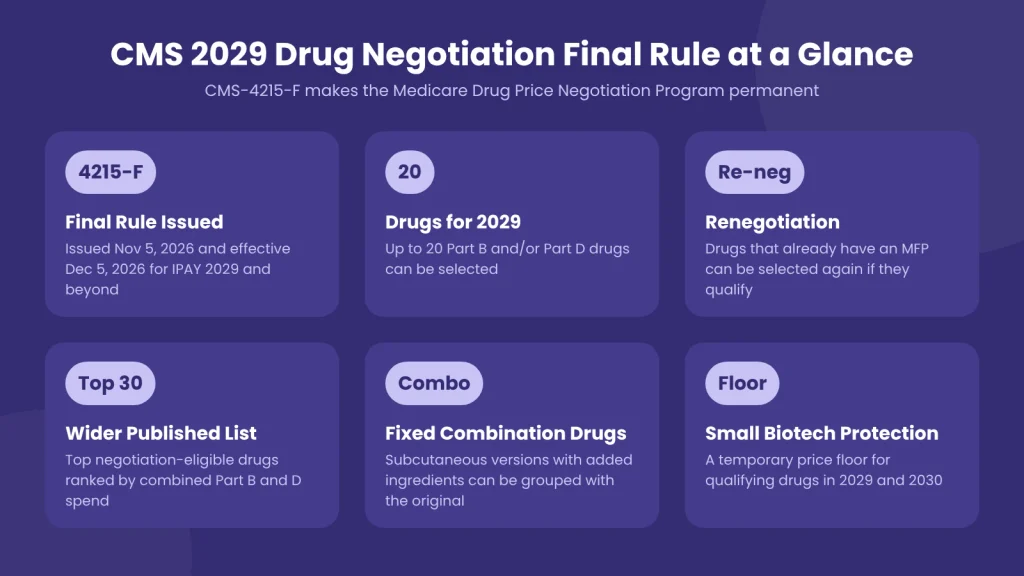
The final rule is CMS-4215-F. It was issued on November 5, 2026, published in the Federal Register on November 9, 2026 and took effect on December 5, 2026.
The main change is structural. For IPAY 2026 through 2028, the statute told CMS to run the program through program instructions and guidance. With that authority expiring, CMS is codifying the program for 2029 and beyond. The policies now sit in federal regulation, which makes them more stable and harder to change without formal rulemaking.
The CMS 2029 drug negotiation rules build on three completed cycles. CMS kept most of what it had been doing and revised some policies based on experience.
Up to 20 Drugs Can Be Selected for 2029
For IPAY 2029 and each later year, CMS can select up to 20 drugs. They can be Part B drugs, Part D drugs or products paid under both.
There are two additions to that list:
- Renegotiation. CMS may also pick drugs that already have an MFP for renegotiation, if they meet the eligibility and selection criteria.
- A wider published list. Alongside the selected drugs, CMS will release the top negotiation-eligible drugs, up to 30, ranked by combined Part B and Part D spending. The list provides additional transparency into the current drug selection process. However, CMS cautions that it should not be treated as a prediction of which drugs may be selected in future negotiation cycles.
Greater Transparency in Drug Selection and Negotiation
CMS describes transparency as a focus of the codified policies. In practice, that includes:
- Published selection criteria for which drugs qualify and how they’re ranked.
- Manufacturer data requirements. Manufacturers must submit pricing data, including non-FAMP information, along with other information CMS needs.
- Outside input. Manufacturers and other interested parties, including patients, can voluntarily submit evidence about selected drugs and their therapeutic alternatives.
- Published results. CMS will publish each agreed-upon MFP and later an explanation of how it was reached.
Changes to Drug Eligibility and Selection
Three eligibility policies are worth knowing, because they affect which drugs stay in or leave the program.
Generic and biosimilar competition. A drug isn’t eligible for selection, and a selected drug can be removed, once a generic or biosimilar that references it is approved and is being marketed. CMS calls this “Bona Fide Marketing.” The rule sets out how CMS decides whether a competing product is truly on the market, when it reviews that question and how it keeps monitoring.
Fixed combination drugs. CMS closed what it viewed as a loophole. Its concern was that a manufacturer could add an ingredient to create a new formulation with a different route of administration and so avoid selection or the MFP. Under the final rule, when products from the same application holder share active ingredients and the difference comes from an added ingredient that creates a new formulation and route, CMS will group all of their dosage forms and strengths together.
CMS gives an example that matters for infusion practices. A product combining an active ingredient with hyaluronidase is grouped with the same holder’s product that contains only that ingredient. In other words, a subcutaneous version of an infused drug may be treated as the same drug for negotiation.
Orphan drugs. The rule also clarifies how CMS treats products that previously qualified for the orphan drug exclusion when an indication approval is withdrawn.
Renegotiation of Previously Selected Drugs
Renegotiation means CMS and the manufacturer revisit an MFP that’s already in place. The final rule codifies the criteria, the data submissions and the process, which follow the original negotiation methods as closely as practicable.
Two points for providers:
- Renegotiation isn’t automatic. A drug has to meet the eligibility and selection criteria first.
- The existing price counts. For IPAY 2029 and later, CMS will take the drug’s current agreed-upon MFP into account as one of the factors.
If a drug your practice uses is renegotiated, its Medicare payment basis can change again.
Temporary Floor for Small Biotech Drugs
Some drugs from small manufacturers were fully excluded from negotiation in the first three cycles. That exception covered IPAY 2026 through 2028.
For IPAY 2029 and 2030, these drugs can be selected, but with a protection. The temporary floor stops CMS from offering a price below it, or agreeing to a counteroffer below it, for a qualifying small biotech drug. CMS also changed how one pricing measure is treated when it calculates the ceiling price for certain of these drugs.
For practices, the takeaway is that the negotiated price for a qualifying small biotech drug can’t go below that floor in these two years.
Medicare Drug Price Negotiation Program for 2029: Important Dates
The following dates come from CMS’s official IPAY 2029 timeline:
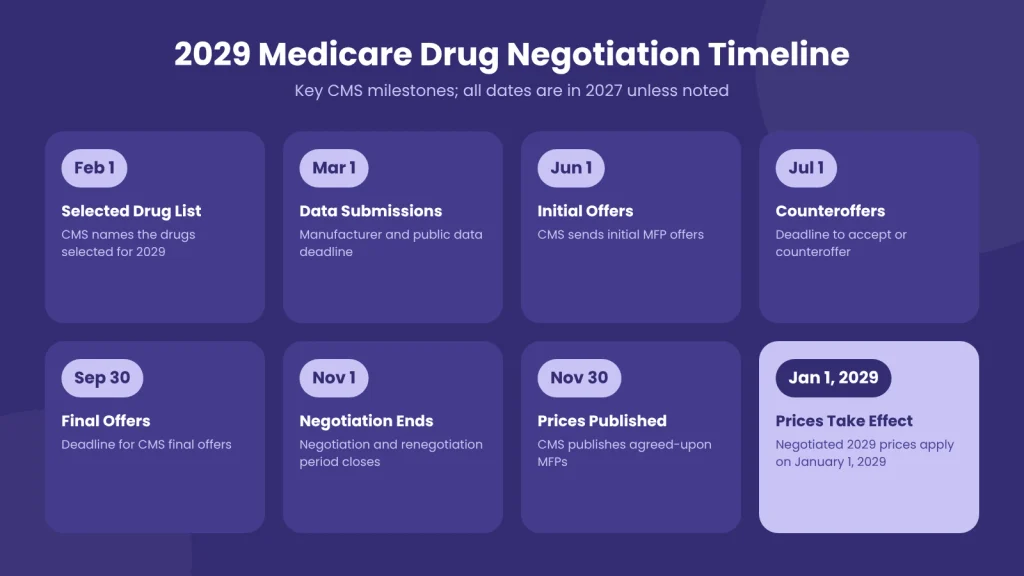
| Date | CMS milestone |
| November 5, 2026 | CMS issues the IPAY 2029 final rule |
| December 5, 2026 | Final rule becomes effective |
| February 1, 2027 | CMS publishes the selected drug list, any renegotiation selections and the top negotiation-eligible drugs |
| February 28, 2027 | Deadline for manufacturers to sign program agreements |
| March 1, 2027 | Deadline for manufacturer and public data submissions |
| Spring 2027 | Patient roundtables and at least one clinical town hall |
| June 1, 2027 | CMS sends initial MFP offers |
| July 1, 2027 | Deadline to accept the initial offer or submit a counteroffer |
| September 30, 2027 | Deadline for CMS to send final MFP offers |
| October 31, 2027 | Deadline for manufacturers to accept or reject the final offer |
| November 1, 2027 | Negotiation and renegotiation period ends |
| November 30, 2027 | CMS publishes agreed-upon MFPs |
| March 1, 2028 | CMS publishes explanations of agreed-upon MFPs |
| January 1, 2029 | Agreed-upon 2029 MFPs take effect |
Important: The 2029 negotiated drug prices for Medicare don’t exist yet. Anyone searching for a 2029 price list today won’t find one. The first concrete information arrives on February 1, 2027, when CMS names the drugs. The prices follow by November 30, 2027.
Medicare Part B Drug Reimbursement: What Providers Should Understand
How Medicare Part B Drug Reimbursement Works
Part B drugs work on a “buy and bill” model. The practice purchases the drug, stores it, administers it and then bills Medicare for both the drug and the administration service.
According to CMS’s Part B drug payment limits overview, most drugs and biologicals have a payment limit of 106% of average sales price. The additional 6% is the statutory add-on under the standard ASP-based payment methodology. Actual provider costs for purchasing, storing and administering drugs can vary. After the 2% sequestration reduction, the amount a practice receives is lower than the published limit.
There are exceptions to the standard method. Biosimilars, new drugs in their initial sales period and certain vaccines, for example, each have their own payment rules.
Payment depends on the claim being right. The drug is billed with a HCPCS code, usually a J-code, and the number of billing units must match the dose given. A unit error on a high-cost drug can mean thousands of dollars overpaid or underpaid on a single claim.
Part D works differently. The pharmacy buys and dispenses the drug, and the patient’s drug plan pays the pharmacy. The practice usually isn’t in the payment chain.
How the Maximum Fair Price May Affect Part B Drug Payments
For selected Part B drugs, the payment formula changes. Beginning in IPAY 2028, the payment limit for a selected Part B drug is 106% of the MFP. The patient’s 20% coinsurance is then calculated on the MFP as well.
This payment methodology comes from the Inflation Reduction Act and applies beginning with IPAY 2028. It is not a new reimbursement formula created by the 2029 final rule. The 2029 rule governs how drugs are selected and how prices are negotiated.
A hypothetical example shows why the formula matters:
| Before MFP | After MFP | |
| Payment basis | ASP of $2,000 | MFP of $1,200 |
| Medicare payment limit (106%) | $2,120 | $1,272 |
| Add-on amount (6%) | $120 | $72 |
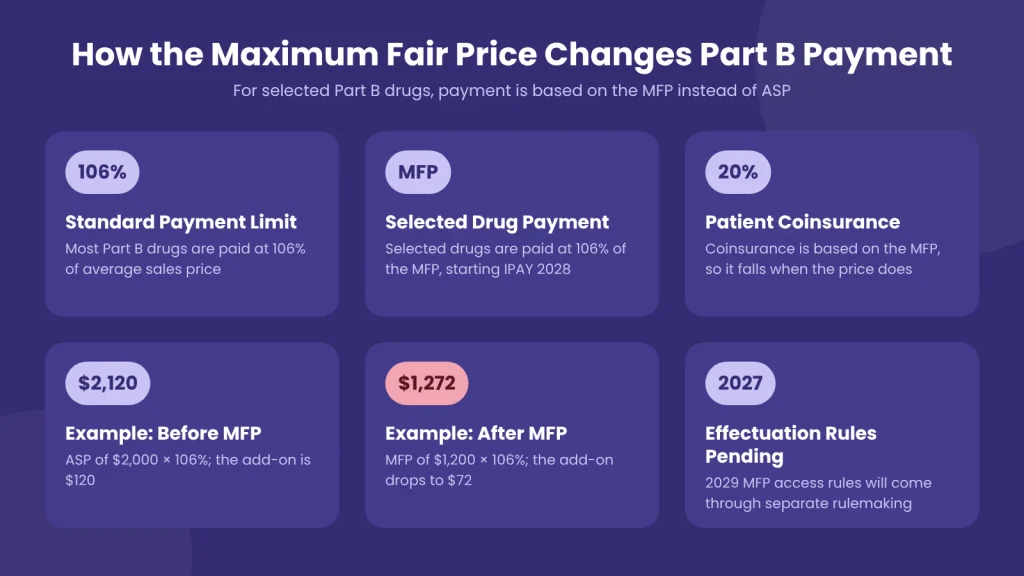
Illustrative figures only, before sequestration. Actual amounts depend on the drug.
Two things change in this example. The payment for the drug drops, and so does the add-on, because 6% of a smaller number is a smaller number.
For IPAY 2028, CMS’s draft effectuation guidance describes two ways manufacturers may provide Part B providers access to the MFP: by ensuring the provider can acquire the drug at or below the MFP, or by retrospectively reimbursing the difference between the provider’s acquisition cost and the MFP. However, CMS has stated that effectuation policies for IPAY 2029 and later years will be established through separate rulemaking in 2027. Therefore, providers should wait for the finalized 2029 requirements before changing their purchasing or reconciliation workflows.
Here is what’s confirmed and what isn’t:
- Confirmed for 2028: The 106% of MFP payment limit applies to selected Part B drugs. CMS planned to issue final effectuation guidance for 2028 in fall 2026.
- Not yet set for 2029: Effectuation policies for 2029 and later will be codified through a separate rulemaking in calendar year 2027.
Until that guidance is final, practices shouldn’t change their billing processes based on assumptions.
Medicare Part B Drug Reimbursement Challenges
Even before negotiated prices, Medicare Part B drug reimbursement is hard to get right. Common problems include:
- Acquisition cost above payment. A practice can end up “underwater” when it pays more for a drug than Medicare reimburses.
- HCPCS coding and billing units. The wrong code or unit count is one of the most common drug billing errors.
- Drug wastage documentation. Discarded amounts from single-dose containers have to be documented and reported correctly.
- Coverage and medical necessity. The diagnosis must support the drug under national and local coverage policies.
- Payer differences. Medicare Advantage and commercial plans may pay differently from traditional Medicare.
- Reconciliation. Matching drug purchases to payments received takes time, and many practices don’t do it by drug.
Retrospective MFP refunds would add another item to reconcile: money coming from a manufacturer, separate from the Medicare payment.
What Oncology, Infusion and Specialty Practices Should Monitor
Practices in oncology, rheumatology, ophthalmology, neurology, gastroenterology and infusion care have the most exposure. They should watch:
- The selected drug list on February 1, 2027
- Drug-specific payment updates in the quarterly Part B payment limit files
- Manufacturer arrangements for providing the MFP, whether by upfront pricing or refunds
- Inventory and purchasing costs for affected drugs
- Payment delays and discrepancies once MFP-based payment starts
Not every Part B drug will see a payment reduction. The program applies only to selected drugs, and the effect on a practice depends on the drug, the payment rules in force and that practice’s own purchasing terms.
Medicare Drug Price Reductions: How Could They Affect Healthcare Providers?
Potential Changes in Drug-Related Revenue
Medicare drug price reductions lower program and patient costs. For a practice, they can also lower revenue per dose of a selected drug. The dollar add-on shrinks with the price, while the work of storing, preparing and administering the drug stays the same.
The exposure is different for every practice. One that rarely uses a selected drug will hardly notice. One that administers it every day needs to model the impact drug by drug.
Impact on Cash Flow and Working Capital
High-cost drugs tie up cash. A practice pays its distributor first and waits for payment afterward. Negotiated prices can affect that cycle in several ways:
- Purchasing and inventory costs may or may not fall at the same time as payment.
- Refund timing. If the MFP is provided through a retrospective refund, the practice carries the difference until the refund arrives.
- Reconciliation workload increases, because each affected claim has two components to track.
- Forecasting becomes harder for specialty practices that depend on drug revenue.
Impact on Patient Access and Treatment Costs
For patients, lower prices can mean lower costs. Because coinsurance is based on the MFP, out-of-pocket costs for a selected Part B drug fall when the price does.
On the Part D side, plans must include selected drugs with an MFP in effect on their formularies. That supports access at the pharmacy.
Practices should make sure front-desk and financial counseling staff quote cost-sharing based on current payment amounts, so patients aren’t given outdated estimates.
Why Providers Should Review Their Drug Reimbursement Strategy
These Medicare reimbursement changes reward preparation. A sensible review covers four steps:
- Identify exposure. List your highest-volume Part B drugs and note which are single-source brands with high Medicare spending.
- Review history. Pull utilization, acquisition cost and reimbursement for each of those drugs.
- Evaluate purchasing. Talk to distributors and group purchasing organizations about how MFP pricing will be handled.
- Monitor guidance. Follow CMS updates and your Medicare Administrative Contractor (MAC).
How 2029 Medicare Drug Price Changes Could Affect Medical Billing
Medicare Claims Processing for Selected Drugs
Accurate Medicare claims processing for a selected drug starts with knowing the drug is selected. Billing teams will need to:
- Flag selected drugs in the charge master and practice management system
- Confirm the correct HCPCS code and any payer-required modifiers
- Report units and dosage accurately
- Keep documentation that supports the claim
- Check current Medicare payment instructions before submitting
Medicare Billing Guidelines for Physician-Administered Drugs
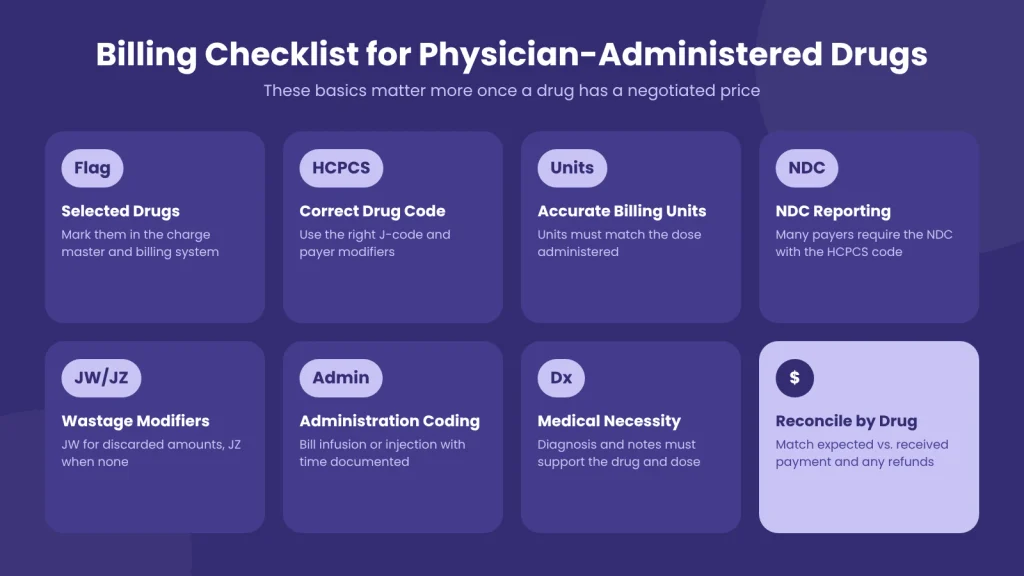
The core Medicare billing guidelines for physician-administered drugs don’t change because a drug has an MFP. They become more important:
- Drug administration coding. The infusion or injection service is billed separately from the drug, with the correct administration code and time documentation.
- National Drug Code (NDC) reporting. Many payers require the NDC along with the HCPCS code.
- JW and JZ modifiers. For drugs from single-dose containers, JW reports the discarded amount and JZ reports that nothing was discarded.
- Wastage documentation. The record should show the amount administered and the amount discarded.
- Medical necessity. The diagnosis and clinical notes must support the drug and dose.
Preventing Medicare Drug Billing Errors
Most drug claim problems come from a short list of errors:
- Incorrect or outdated drug codes
- Incorrect units of service
- Outdated payment information in the billing system
- Documentation that doesn’t match the claim
- Missing or incorrect modifiers
- Wrong payer or coverage information, including Part B versus Part D confusion
Managing Medicare Drug Claim Denials
When a drug claim is denied, the amount at stake is usually large. A structured approach helps:
- Identify the denial reason code and group similar denials together.
- Correct the coding, units or documentation issue.
- Submit a corrected claim or appeal, as appropriate.
- Track recurring denials by drug and payer to find the root cause.
A dedicated denial management process keeps high-dollar drug claims from aging out.
Maintaining Medical Billing Compliance
Medical billing compliance for drug claims depends on staying current:
- Monitor CMS policy changes and quarterly payment file updates
- Update internal billing procedures when guidance changes
- Train billing and coding staff on selected drugs and modifier rules
- Keep accurate purchase, administration and wastage records
- Audit drug claims periodically
Revenue Cycle Management Strategies for the 2029 Medicare Drug Pricing Changes
Review Drug-Related Revenue Cycle Workflows
Start with how a drug charge moves through your practice today. Check charge capture at the point of administration, claim submission timing, payment posting at the drug line level and follow-up on unpaid drug claims. Look for revenue leakage, such as doses given but not billed.
Strengthen Medicare Eligibility and Coverage Verification
Before treatment, confirm:
- The patient’s Medicare coverage is active, and whether it’s traditional Medicare or Medicare Advantage
- Whether the drug is covered under Part B or Part D for that patient
- Any coverage policy requirements for the drug and diagnosis
- Prior authorization, where the plan requires it
Improve Accounts Receivable and Payment Reconciliation
Negotiated prices make reconciliation more important. Good revenue cycle management for healthcare providers in this area means:
- Monitoring unpaid drug claims separately from other claims
- Comparing expected payment with received payment for each drug
- Investigating underpayments quickly
- Tracking any manufacturer refunds against the claims they relate to
- Keeping accounts receivable reports accurate
Our accounts receivable management service is built around this kind of follow-up.
Conduct Regular Medical Billing Audits
A medical billing audit focused on drugs should test coding accuracy, billing units, modifiers, documentation consistency and payment variances. Running one before 2029 gives you a baseline to compare against.
Use Data and Reporting to Monitor Financial Performance
Useful reports for managing these Medicare reimbursement challenges include:
- Drug-level reimbursement and margin reports
- Denial trends by drug and payer
- Payment variance reports
- Accounts receivable aging for drug claims
- Revenue by specialty and service line
How Outsourced Medical Billing Can Help Providers Adapt to Medicare Drug Pricing Changes
Accurate Medical Coding and Charge Entry
Drug claims depend on precise codes, units and modifiers. iSolve RCM’s medical coding services review drug and administration coding against documentation, which helps reduce avoidable claim errors.
Medicare Claims Management and Submission
Through our outsourced medical billing services, claims are prepared, scrubbed, submitted on time and tracked until they’re resolved.
Denial Management and Follow-Up
Our denial management team analyzes denial patterns, corrects the underlying issue and pursues appeals to help practices recover legitimate reimbursement.
Accounts Receivable Management
With accounts receivable management, outstanding claims are followed up, underpayments are identified and aging balances are kept under control.
Revenue Cycle Management Support
Our revenue cycle management services bring billing, coding, claims, payment posting and reporting together, so reimbursement changes are handled in one coordinated process.
Medical Billing Audits for Better Reimbursement Accuracy
Periodic medical billing audits help identify coding gaps, documentation issues and payment discrepancies before they become recurring losses.
iSolve RCM supports a range of specialties, including practices that rely on physician-administered drugs. See our oncology billing services for infusion and chemotherapy billing support. If you’re comparing options, our guide to in-house vs. outsourced medical billing explains the trade-offs. For other Medicare payment changes, read our CMS 2027 Physician Fee Schedule guide.
How Healthcare Providers Can Prepare for Medicare Drug Price Changes in 2029

- Identify the Medicare Part B drugs your practice administers.
- Check CMS’s 2029 selected drug list when it’s published on February 1, 2027.
- Review drug acquisition costs and reimbursement trends.
- Update drug coding and billing workflows when applicable guidance is released.
- Train billing and coding teams on the changes.
- Review claim denials and underpayments.
- Reconcile drug-related payments regularly.
- Conduct periodic medical billing audits.
- Monitor CMS updates and MAC guidance.
- Assess whether your current RCM processes can handle future reimbursement changes.
Conclusion: Prepare Your Revenue Cycle for Medicare Drug Price Changes in 2029
CMS’s final rule makes the Medicare Drug Price Negotiation Program a lasting part of how Medicare pays for drugs. Up to 20 more drugs, including physician-administered Part B drugs, can receive negotiated prices that take effect on January 1, 2029.
The 2029 prices aren’t published yet. The drug list arrives February 1, 2027, and the prices by November 30, 2027. That gives practices time, and the best use of it is to get the basics right: accurate drug coding and units, clean documentation, payment reconciliation by drug and a clear view of acquisition cost against reimbursement.
If you’d like help reviewing your drug billing and revenue cycle processes before the new prices take effect, iSolve RCM can help.
Frequently Asked Questions About Medicare Drug Price Negotiations for 2029
What Is the Medicare Drug Price Negotiation Program?
It’s a program created by the Inflation Reduction Act of 2022 that lets CMS negotiate prices directly with manufacturers for certain high-spending, single-source drugs and biologics. The negotiated price is called the maximum fair price, and it applies to Medicare beneficiaries who use the selected drug.
Can Medicare Negotiate Drug Prices?
Yes. Since the Inflation Reduction Act, CMS has had the authority to negotiate prices for a limited number of drugs each year. The drugs must be high-expenditure, single-source products without generic or biosimilar competition, and CMS must select them under the statutory criteria.
What Is the Medicare Maximum Fair Price?
The maximum fair price, or MFP, is the price CMS and a manufacturer agree on for a selected drug. Manufacturers must make it available for eligible Medicare beneficiaries. For selected Part B drugs, Medicare’s payment limit is based on the MFP instead of average sales price.
What Are the 2029 Medicare Negotiated Drug Prices?
They haven’t been set. CMS will publish the list of drugs selected for 2029 by February 1, 2027. The agreed-upon maximum fair prices are due by November 30, 2027, and they take effect on January 1, 2029.
How Many Drugs Will CMS Select for 2029?
CMS can select up to 20 drugs for 2029. They may be covered under Part D, payable under Part B or both. CMS may also select drugs that already have a negotiated price for renegotiation if they meet the eligibility and selection criteria.
Does the Medicare Drug Price Negotiation Program Affect Part B Drugs?
Yes. Part B drugs, which are typically administered by clinicians, became part of the program with the 2028 cycle and can be selected for 2029. Part D drugs are dispensed by pharmacies and were the only drugs included in the first two cycles.
How Will Medicare Drug Price Changes Affect Medical Billing?
Billing teams will need to identify selected drugs, keep payment information current, report codes, units and modifiers accurately and reconcile payments by drug. If manufacturers provide the negotiated price through refunds, practices will also need to track those refunds against claims.
Will Medicare Part B Drug Reimbursement Change in 2029?
Only for selected drugs. Under the Inflation Reduction Act, their payment limit is 106% of the maximum fair price, a method that begins with IPAY 2028. The effect in 2029 depends on which drugs CMS selects and on effectuation policies that CMS plans to codify through rulemaking in 2027.
What Is the Difference Between Medicare Part B and Part D Drug Coverage?
Part B covers drugs that are usually administered by a clinician, such as infusions and injections. The practice buys the drug and bills Medicare. Part D covers outpatient prescription drugs that patients get from a pharmacy, paid through the patient’s drug plan.
How Can Medical Practices Prepare for Medicare Reimbursement Changes?
Identify your high-volume Part B drugs, watch for the selected drug list, review acquisition costs and payments, keep coding and units accurate, audit drug claims and reconcile payments regularly. Follow CMS and MAC guidance before changing any billing process.
Sources:
- CMS: Medicare Drug Price Negotiation Program and Medicare Prescription Drug Benefit Program Final Rule Fact Sheet (CMS-4215-F)
- CMS: IPAY 2029 Negotiation Program Timeline
- Federal Register: CMS-4215-F Final Rule, November 9, 2026 (91 FR 72176)
- CMS: Part B Drug Payment Limits Overview
- CMS: Negotiation Program Regulations, Guidance and Policy Documents