

Ask a nephrologist what a good day looks like and they’ll tell you about patients. Ask the person running the billing and you’ll get a different answer, usually with a sigh somewhere in the middle.
Nephrology is one of those specialties where the medicine and the money get tangled in odd ways. A dialysis patient is paid for by the month, not by the visit. The right code depends on how old that patient is on the last day of the month. A hospital stay halfway through can change the whole claim. Get one small detail wrong and the claim either bounces back or, worse, gets paid at the wrong rate and nobody notices for a year.
If that sounds familiar, this post is for you. We’ll walk through the nephrology billing challenges we see most often, why they keep happening, and what actually helps. Some fixes cost nothing but a better habit. Others are the kind of work you hand to a team that does nephrologist revenue cycle management all day long.
One caveat before we start. Rules change by payer, by Medicare contractor and by year. Use this as a practical guide, then check the details against current CMS, AMA and payer policies.
Why nephrology medical billing doesn’t behave like other specialties
Most specialties bill visit by visit. See the patient, code the visit, send the claim. Done.
Dialysis patients don’t work that way. For people with end-stage renal disease (ESRD), outpatient physician care is generally paid through a monthly capitation payment, or MCP. One payment covers most of the nephrologist’s dialysis-related management for the month. Which code you use depends on the patient’s age and how many face-to-face visits actually happened.
Then you’ve got everything else on the same desk: CKD clinic visits, hospital consults, acute kidney injury, vascular access, transplant follow-up, home dialysis. So nephrology medical billing ends up being a mix of monthly billing, per-day billing, procedure codes, time-based visits and a lot of coordination with the dialysis facility, which bills separately.
That’s why generic billing teams struggle here, and why nephrology revenue cycle management needs people who’ve seen these claims before.
The ten problems, at a glance
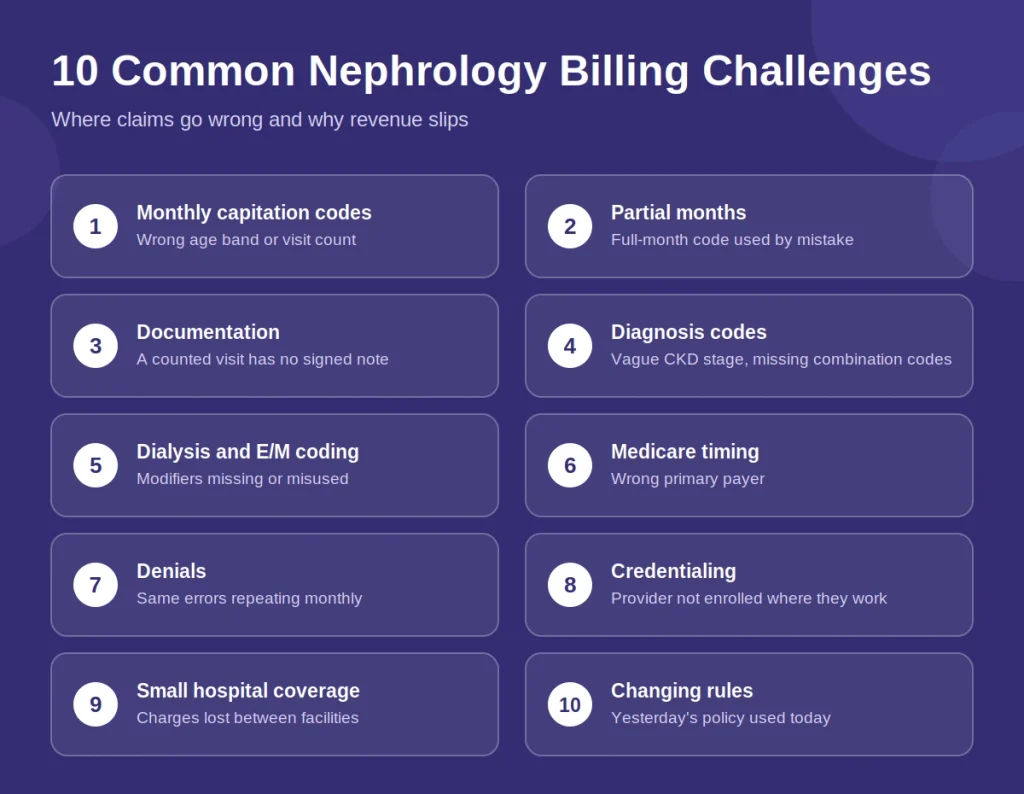
| # | Problem | What usually goes wrong |
| 1 | Monthly capitation codes | Wrong age band or visit count |
| 2 | Partial months | Full-month code used by mistake |
| 3 | Documentation | A counted visit has no signed note |
| 4 | Diagnosis codes | Vague CKD stage, missing combination codes |
| 5 | Dialysis and E/M coding | Modifiers missing or misused |
| 6 | Medicare timing | Wrong primary payer |
| 7 | Denials | Same errors repeating monthly |
| 8 | Credentialing | Provider not enrolled where they’re working |
| 9 | Small hospital coverage | Charges lost between facilities |
| 10 | Changing rules | Yesterday’s policy used today |
1. Picking the wrong monthly capitation code
If you only fix one thing on this list, fix this one. It touches every dialysis patient, every month, so a small mistake gets repeated at scale.
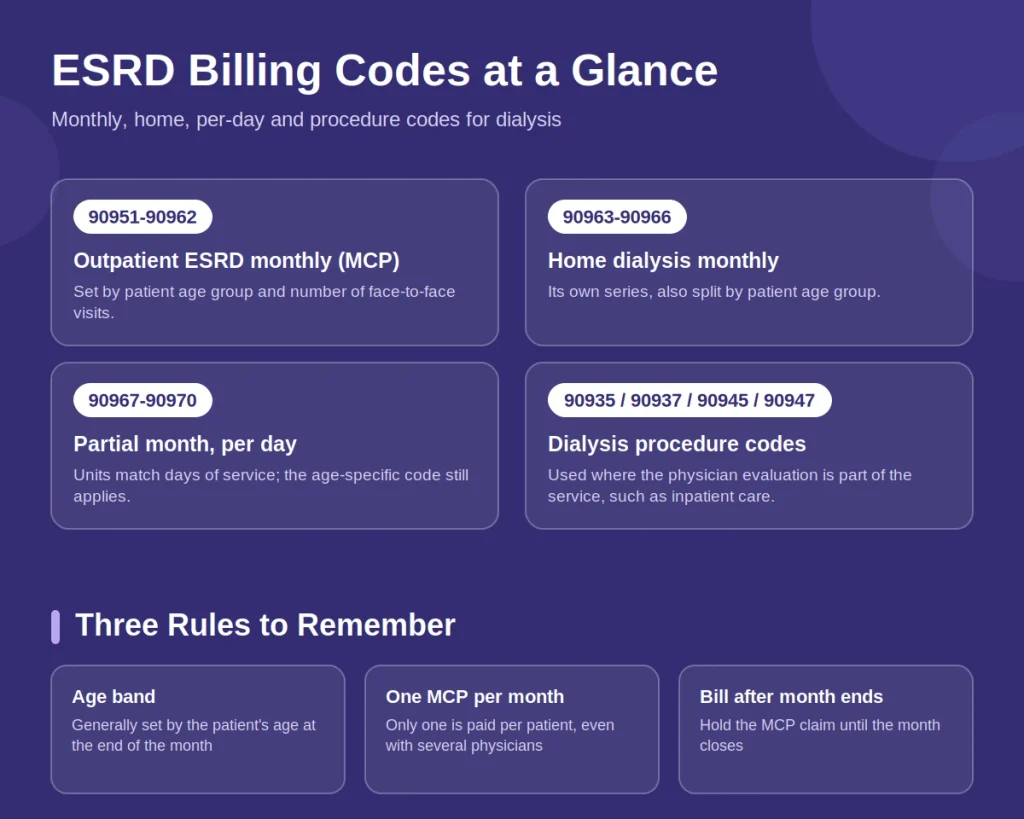
Outpatient ESRD services use CPT codes 90951 through 90962. They’re split by the patient’s age group and by the number of face-to-face visits in the month. For patients 20 and older, that means one visit, two to three visits, or four or more. Home dialysis patients have their own series, 90963 through 90966.
Three rules catch people out. The patient’s age is generally set by their age at the end of the month, so someone who turns 20 on the 14th changes code groups. Only one MCP can be paid per patient per month, even if several physicians in the group saw them. And the claim should go out after the month is over. Sending it early is one of the quickest ways to get a payer’s attention for the wrong reasons.
What helps is boring but effective. Keep a running visit count per patient, by provider, that your biller can see. Run an age check on the last day of the month. Hold MCP claims until the month closes. And pull a small sample every quarter to see whether the same mistake is hiding in plain sight. If your team doesn’t have time for all of that, outsourced nephrology billing support can catch these errors before the claim goes out.
2. Partial months that don’t fit the calendar
Patients don’t always start, stop or stay on dialysis in tidy calendar months. They land in the hospital. They move between facilities. They get a transplant, recover kidney function, or sadly pass away.
When dialysis services run for less than a full month, the per-day codes, CPT 90967 through 90970, usually come into play instead of the full-month codes. The units need to match the days of service, and the age-specific code still matters.
The usual slip is billing a full MCP out of habit. The second most common is getting the unit count wrong. And more than once we’ve seen a claim go out untouched after a patient’s status changed on the 12th, because nobody told billing.
The simplest fix is a status-change flag. Any time a dialysis patient is hospitalized, transferred, transplanted or discharged, the account gets a human review before a claim is built. Pair that with a one-page chart showing when to use monthly versus per-day codes, and reconcile your visit log against the dialysis facility’s records so both sides tell the same story.
3. Documentation that doesn’t back up the claim
Every payer says the same thing: if it isn’t documented, it didn’t happen. In nephrology the stakes are higher, because one monthly claim represents a whole month of care.
Medicare contractors generally expect a signed note for each face-to-face visit that supports the code you billed. Bill four visits, find three notes, and you’ve got a payment problem and a compliance problem at the same time.
We usually see the same handful of gaps. Visits get recorded in the dialysis unit’s system and never make it into the practice’s EHR. Notes are unsigned or signed weeks late. Copy-and-paste text doesn’t match what happened in the room. Or there’s nothing showing a complete monthly assessment of the patient.
Templates built for nephrology help, because they nudge providers to capture dialysis adequacy, access status, medications and the assessment itself. A hard rule helps even more: no claim leaves until every counted visit has a signed note. A quick chart-to-claim match at month end takes less time than you’d think and saves a lot of arguments later. And keep training short and frequent. Ten minutes at a staff meeting beats a long lecture once a year.
4. Diagnosis codes that are too vague
Nephrology billing and coding lives and dies on diagnosis detail. Vague diagnoses lead to medical-necessity denials. Diagnosis combinations that break the coding rules lead to rejections.
Take chronic kidney disease. The stage matters. Stages 1 through 5 and ESRD each have their own codes, and stage 3 splits into 3a and 3b. If the chart says stage 4 and the claim says unspecified CKD, you’ve left clarity, and sometimes money, on the table.
Then come the combination rules. Kidney disease linked to diabetes or hypertension is typically reported with a combination code, plus an additional code for the CKD stage. Dialysis status can be reported on its own too. Payers expect those relationships to be clear.
Ask providers to document the stage and the underlying cause every time, not just at the first visit. Keep a one-page cheat sheet of your most common diagnosis pairings. Set claim-scrubbing rules to flag unspecified kidney codes before submission. And update your code lists every October when the new ICD-10-CM set takes effect. This is also where good medical coding support pays for itself, since a single correction can protect a payment that repeats every month.
5. Dialysis CPT codes, E/M visits and the modifier question
Here’s a question that trips up even experienced billers. When do you bill a dialysis procedure code, when do you bill the MCP, and when does a separate visit make sense?
A few dialysis CPT coding guidelines worth keeping handy:
- 90951 through 90970 cover outpatient ESRD services, billed monthly or per day.
- 90935 and 90937 (hemodialysis) and 90945 and 90947 (other dialysis) are procedure codes used in settings like inpatient care, where the physician evaluation is part of the service. Single evaluation versus repeated evaluation matters here.
- Hospital dialysis, ICU care, consults and AKI management follow different logic from outpatient MCP billing.
- A separate E/M on the same day as a dialysis procedure generally needs a significant, separately identifiable reason, documented clearly, and usually modifier 25.
For CKD patients who aren’t on dialysis, regular office visit codes apply, with the level based on medical decision-making or total time under current AMA rules.
What works is a simple flowchart by place of service: outpatient dialysis, inpatient, office, home. Teach providers what makes a visit separately identifiable and have them write it down in the note. Check modifier use monthly, since overuse and underuse both draw attention. And re-check your references every January, because CPT changes arrive on a yearly schedule whether you’re ready or not.
6. Medicare timing and the payer maze
ESRD insurance is its own puzzle. Medicare entitlement for ESRD follows timing rules tied to when dialysis begins, and there’s a coordination period during which an employer group health plan can remain primary. Patients may also move between Medicare Advantage, traditional Medicare, Medicaid, and commercial plans, making accurate eligibility verification essential. Understanding these rules through a practical resource like the Medicare insurance guide can help billing teams navigate payer coordination and reduce avoidable claim issues.
When the wrong payer gets billed first, claims get denied, delayed, or paid and then taken back.
Say a patient keeps employer coverage after starting dialysis and the claim goes to Medicare first. That’s a denial waiting to happen. Same story when a patient changes plans in July and nobody updates registration, or when required ESRD paperwork is late.
Verify coverage at the start of every month for dialysis patients, not just at registration. Track each patient’s dialysis start date so you know who should be primary. Give one person ownership of secondary payer questionnaires and enrollment forms. And ask patients about coverage changes at every visit. It sounds basic because it is, and it works.
7. Nephrology claim denials that keep coming back
Every practice has denials. The healthy ones fix the cause. The struggling ones fight the same nephrology claim denials month after month.
The usual suspects are inactive coverage or the wrong primary payer, duplicate or frequency conflicts (two MCPs in one month from the same group), diagnosis codes that don’t support the service, missing authorizations, coding or modifier errors, and claims that simply sat too long and missed the filing deadline.
Track denials by reason code and payer, not just by dollar amount. The pattern tells you where the process is leaking. Work new denials within 48 hours, because aging makes everything harder. Keep appeal templates for your top five reasons so nobody starts from a blank page. And if the same denial shows up three times, stop appealing and change the step upstream.
Dedicated denial management is one of the best investments a nephrology practice can make. Repeat denials quietly cost far more than one-off mistakes.
8. Credentialing and enrollment delays
You can only bill for services you’re properly enrolled and credentialed to provide, at each location, with each payer. In nephrology that list gets long fast.
A nephrologist might split time between several dialysis units, a couple of hospitals, an outpatient clinic and a home program. Each can have its own requirements. Bring on a new partner, a locum, or a nurse practitioner who’ll do face-to-face visits, and the enrollment list grows again.
The usual failures are a new provider seeing patients before enrollment is complete, revalidation dates slipping by, CAQH profiles going stale, and practice locations not being updated with payers.
Keep a master calendar of licenses, board certifications and payer revalidation dates. Start credentialing 90 to 120 days before a new provider’s first day (timelines vary, and early is cheap insurance). Give one person ownership of CAQH attestations. If your admin team is already stretched, outsourced provider credentialing and enrollment support can take the whole thing off their plate.
9. Small hospitals and the nephrology coverage puzzle
This one doesn’t get enough attention. The challenges small hospitals face with nephrology coverage are real, and they land straight on the billing desk.
Smaller and rural hospitals often can’t support a full-time nephrologist. Coverage comes from a visiting physician, a shared group, locum tenens providers or a tele-nephrology arrangement. That creates problems:
- Notes written in the hospital’s system never reach the group’s billing team.
- Each hospital has its own privileging process on top of payer enrollment.
- Locum and coverage arrangements have to be handled correctly with each payer, or claims get denied.
- Contracts for stipends, professional fees and call coverage aren’t always clear about who bills what.
- Volume is low but cases are complex, and there’s rarely a dedicated coder.
- When one physician covers several sites in a day, charges slip between locations.
A few things make a real difference. Standardize charge capture with a simple daily log or mobile tool that works at every facility. Set a rule that hospital notes reach billing within 24 hours. Confirm locum and coverage arrangements with each payer before the first shift. Put in writing, in every coverage contract, who bills for what. And if your volume doesn’t justify hiring a specialist biller, outsourcing can give a small group or hospital expertise they couldn’t afford to hire full time.
10. Rules that keep moving
Nephrology billing isn’t standing still. Telehealth flexibilities have shifted more than once in recent years. Kidney care payment models and quality programs keep evolving. CPT and ICD-10 updates arrive every year, and payers change their own policies on their own schedules.
A rule your biller learned three years ago may not be true today.
Give someone the job of reading CMS, MAC and major payer bulletins every month. Keep a living billing-rules document and date every entry. Before billing telehealth for ESRD-related services or home dialysis visits, confirm current coverage, since requirements can change. And if you join a quality or value-based program, find out how it affects both reporting and reimbursement before you sign up.
What in-house billing really costs
Many practices keep billing in-house because it feels cheaper and more controlled. Sometimes that’s true. Often it isn’t, and the reasons show up slowly.
Someone who truly understands MCP codes, partial-month rules and ESRD payer timelines is hard to find and harder to keep. When that person leaves, the knowledge goes with them. Training a replacement takes months, and mistakes made during those months cost real money. Add software, clearinghouse fees, benefits and management time, and the number gets bigger. Meanwhile busy teams work the easy denials and let the hard ones age.
That’s why more nephrology groups are comparing nephrology medical billing companies that can apply the rules consistently, scale when the practice grows, and keep working when someone’s on vacation.
Numbers worth watching every month
You can’t fix what you don’t measure. Seven numbers give you a clear picture:
- Clean claim rate: claims accepted on first submission. Higher is better.
- Denial rate: many practices aim for the mid single digits or lower, though benchmarks vary.
- Days in A/R: how long it takes to get paid. Lower is better.
- A/R over 90 days: a growing share points to follow-up problems.
- Net collection rate: what you collect versus what you’re contractually owed.
- MCP accuracy: monthly capitation claims coded correctly the first time.
- Charge lag: days between the date of service and charge entry.
Look at them by payer and by provider. Small trends show up early if you’re looking.
A short checklist you can use this week
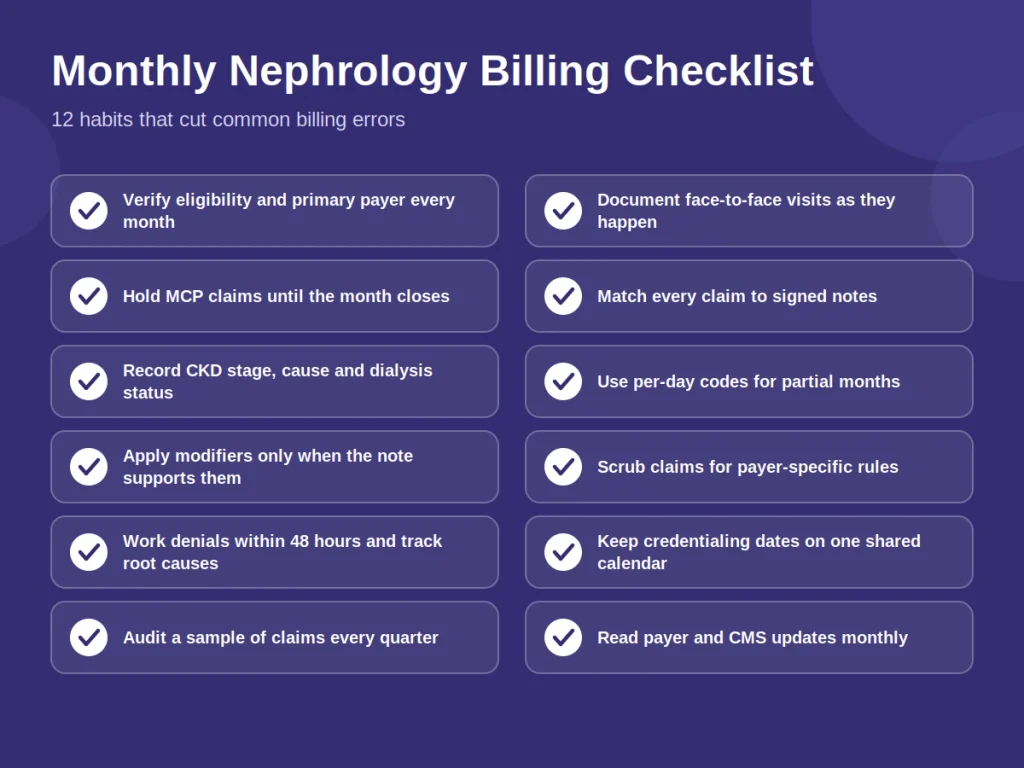
- Verify eligibility and primary payer at the start of every month for dialysis patients.
- Count and document face-to-face visits as they happen, not at month end.
- Hold MCP claims until the month closes and the patient’s age is confirmed.
- Match every claim to signed notes before release.
- Document CKD stage, cause and dialysis status clearly.
- Use per-day codes for partial months, and review every status change.
- Use modifiers only when the note supports them.
- Scrub claims for payer-specific rules before sending.
- Work denials within 48 hours and track root causes.
- Keep credentialing and revalidation dates on one shared calendar.
- Audit a sample of claims every quarter.
- Read payer and CMS updates monthly.
Do those twelve things consistently and most common nephrology billing errors drop fast.
Where iSolve RCM fits in
If your team is stretched thin, or your denial rate keeps creeping up, a dedicated revenue cycle partner can take a lot of this off your shoulders. That’s the job iSolve RCM does.
iSolve RCM is a U.S.-focused revenue cycle company based in Edison, New Jersey. According to the company, it supports more than 200 providers across 45+ specialties. Its services line up with the problems above:
- Eligibility and benefits verification, so coverage issues get caught before a claim goes out
- Coding and clean claim submission
- Payment posting and reconciliation
- Denial management and appeals, aimed at stopping repeat denials at the source
- A/R follow-up on aging claims that internal teams rarely have time to chase
- Provider credentialing and enrollment, including CAQH support
- Billing audits to find underpayments and process gaps
- Regular reporting, so you know where your money stands
A few things practice owners tend to care about: iSolve RCM advertises fees starting as low as 2.99% of monthly collections with no hidden fees (you can see the pricing details up front), says onboarding usually takes one to two weeks depending on practice size and complexity, handles patient information in a HIPAA-compliant way, and offers a free revenue cycle assessment so you can see where revenue may be leaking before you commit.
Whoever you talk to, iSolve RCM included, bring nephrology-specific questions. Ask how they handle MCP age and visit bands, partial-month claims, ESRD payer timelines and charge capture across several facilities. A good partner answers those plainly.
What to look for in a nephrology billing partner
- Real nephrology experience. Ask for specifics on MCP, dialysis procedure codes and ESRD payer rules.
- A visit-tracking process. How do they count and verify face-to-face visits each month?
- Denial analytics. Can they show denials by reason, payer and provider?
- Credentialing support. Included, or an add-on?
- Readable reporting. Ask for a sample.
- Integration. Will it work with your EHR and the facility’s systems?
- Security. HIPAA compliance, access controls and a signed business associate agreement.
- Fair terms. No surprise fees, and a reasonable way out.
FAQs
What are the biggest nephrology billing challenges?
Choosing the right monthly capitation code, billing partial months correctly, keeping documentation complete for every visit, coding CKD and ESRD with enough detail, handling Medicare and secondary payer timing, managing credentialing across sites, and keeping up with rule changes.
What are the most common nephrology billing errors?
Wrong age band or visit count on MCP claims, claims sent before the month ends, missing signed notes, unspecified CKD codes, the wrong primary payer, and missing modifiers when a separate E/M is billed alongside a dialysis procedure.
What CPT codes are used for dialysis billing?
Outpatient ESRD monthly services use 90951 through 90962. Home dialysis monthly services use 90963 through 90966. Partial-month per-day services use 90967 through 90970. Procedure codes like 90935, 90937, 90945 and 90947 apply where the physician evaluation is part of the procedure. Always confirm against the current CPT book and your payer’s policy.
How does the ESRD monthly capitation payment work?
It’s one monthly payment covering most outpatient dialysis-related physician services. The code depends on the patient’s age group and the number of face-to-face visits that month. Only one MCP can be paid per patient per month, even when several physicians are involved.
Why are nephrology claims denied so often?
Usually eligibility or primary payer errors, mismatched visit counts, missing documentation, diagnosis codes that don’t support medical necessity, missing authorizations, or timely filing. Most are preventable with better front-end checks and cleaner documentation.
How can small hospitals manage nephrology coverage and billing?
Standardize charge capture, get hospital notes to billing quickly, confirm credentialing and payer rules for every covering provider, and spell out in contracts who bills for what. An RCM partner with specialty knowledge can fill the expertise gap.
Is outsourcing nephrology billing worth it?
For many practices, yes. It can cut administrative load, improve clean claim rates, speed up payments and keep billing steady when staff are out. It’s especially useful for growing groups and for practices that can’t find experienced billers.
How long does it take to switch to an outsourced billing partner?
It depends on your size and complexity. iSolve RCM says onboarding usually takes one to two weeks, though larger groups may need longer. Ask any vendor for a realistic timeline.
The short version
Nephrology billing is complicated, but it isn’t mysterious. Nearly every serious problem comes back to a handful of causes: wrong monthly codes, partial-month mistakes, thin documentation, vague diagnoses, payer timing surprises and slow follow-up on denials. Fix those and revenue steadies out almost right away.
You don’t have to do it alone. Tighten your own process with the checklist above, or bring in a partner for nephrology revenue cycle management. Either way, the goal is the same: collect every legitimate dollar you’ve earned, with fewer headaches, so your team can get back to patients.