

A knee arthroscopy with meniscectomy (29881) carries a 90-day global period, so the routine follow-up visit three weeks later has already been paid as part of the surgery. Bill that visit as a separate office visit and it is denied. But if the same patient comes in during those 90 days for an unrelated shoulder problem, the visit is payable with modifier 24. The difference between a denial and a payment is one modifier and a note that shows why.
That is the heart of orthopedic surgery billing. Most orthopedic denials do not come from the surgery code itself. They come from what happens around it: visits inside the global period, injections on the same day as an office visit, second procedures during recovery, bilateral and multiple procedures and assistant surgeons. This guide explains global periods, the modifiers that decide payment, the codes orthopedic practices bill most and the 2026 and 2027 changes that affect orthopedic revenue.
Quick answer: Orthopedic surgery billing depends on global periods (0, 10 or 90 days) and modifiers. Routine post-operative visits inside the global period are not billed separately. Use modifier 24 for an unrelated visit during the global period, 25 for a separate problem on the day of a minor procedure, 57 for the decision for major surgery, 58 for a staged procedure, 78 for an unplanned return to the operating room and 79 for an unrelated procedure. Missing or wrong modifiers on these situations are the most common orthopedic denials.
Orthopedic Global Surgical Periods
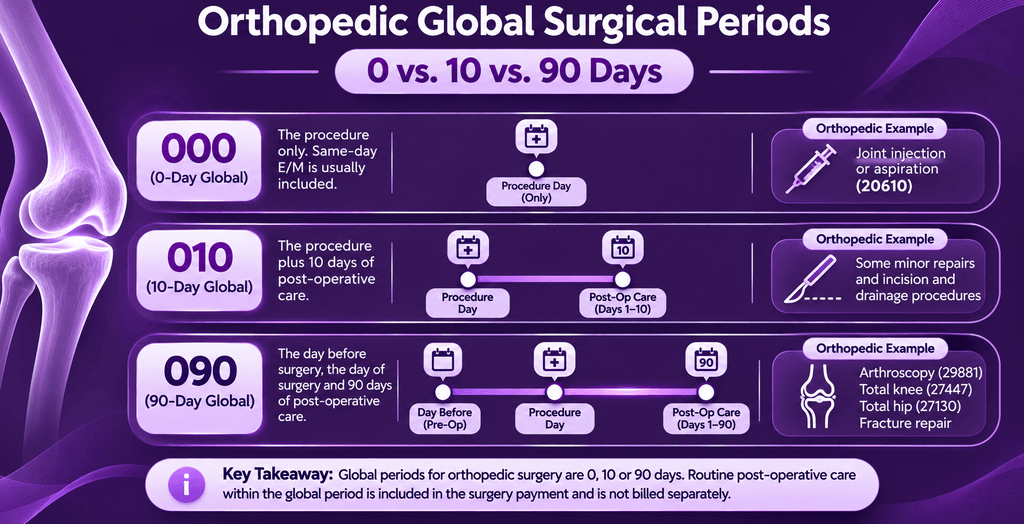
| Global Indicator | What Is Included | Orthopedic Examples |
|---|---|---|
| 000 | The procedure only; same-day E/M usually included unless separately identifiable | Joint injection or aspiration (20610) |
| 010 | The procedure plus 10 days of post-operative care | Some minor repairs and incision and drainage procedures |
| 090 | The day before surgery, the day of surgery and 90 days of post-operative care | Arthroscopy (29881), total knee (27447), total hip (27130), fracture repair |
Source: CMS Medicare Physician Fee Schedule global surgery indicators; CMS Global Surgery Booklet.

Why Is Orthopedic Billing Different From Other Specialties?
Orthopedic billing combines high-value surgery, frequent in-office procedures, imaging, durable medical equipment and long recovery periods in the same practice. One patient can generate a consult, X-rays, an injection, a surgery, 90 days of follow-up, physical therapy referrals and a brace. Each step has its own rules, and the global period ties many of them together.
| Factor | Why It Matters for Billing |
|---|---|
| Global periods | Determine which visits are already paid |
| Laterality and anatomy | Right, left, bilateral and finger or toe modifiers change payment |
| Multiple procedures | Multiple procedure rules reduce payment for secondary procedures |
| Same-day injections and visits | Modifier 25 decides whether the visit pays |
| Implants and supplies | Often billed by the facility, not the surgeon |
| Prior authorization | Common for MRI, arthroscopy and joint replacement |
| Site of service | Office, ASC and hospital rules differ |
How Does the Global Surgical Period Work in Orthopedics?
A global surgical package pays one amount for the surgery and the routine care around it. For a 90-day major surgery, the package includes pre-operative visits the day before and the day of surgery (after the decision to operate), the surgery itself, routine follow-up visits, dressing changes and suture or staple removal and treatment of complications that do not require a return to the operating room. The 90 days start the day after surgery.
Services outside the package are billable with the right modifier: an unrelated problem, a return to the operating room for a complication, a staged procedure or a new, unrelated surgery. If no modifier explains why a service in the global period is separate, the payer treats it as part of the package.
Split care: when another physician provides part of the global
When one surgeon performs the operation and another provides post-operative care, the global fee is split with modifiers 54 (surgical care only), 55 (post-operative management only) and 56 (pre-operative management only). Both physicians bill the same procedure code and date of surgery with their modifier, and the transfer of care must be documented.
What Are the Most Common Orthopedic Modifier Errors?
| Modifier | Correct Use | Common Error |
|---|---|---|
| 24 | Unrelated E/M by the same physician during the post-operative period | Used for routine follow-up of the surgery itself |
| 25 | Significant, separately identifiable E/M on the same day as a minor procedure | Added to every injection-day visit without separate documentation |
| 57 | E/M that resulted in the decision for major surgery, the day before or day of surgery | Replaced with 25, which bundles the visit into a 90-day surgery |
| 58 | Staged or planned related procedure during the global period | Confused with 78, which applies only to unplanned returns |
| 78 | Unplanned return to the operating room for a related problem | Used for procedures done in the office, or without OR documentation |
| 79 | Unrelated procedure during the global period | Missing, so the new procedure is denied as part of the first global |
| 59, XS, XE, XU, XP | Distinct procedure, site, session, service or practitioner | Used to override edits without documentation of a separate site or session |
| RT, LT, 50 | Laterality and bilateral procedures | Missing laterality or using RT and LT where the payer requires 50 |
| F1 to F9, FA, T1 to TA | Specific fingers and toes | Left off, so procedures on different digits look like duplicates |
| 80, 82, AS | Assistant surgeon or non-physician assistant | Billed for procedures where an assistant is not payable |
| 22 | Substantially greater work than usual | Added without documentation of the extra time or difficulty |

These errors usually return as CARC 4 (modifier inconsistent with the procedure), CARC 97 (included in another service) or CARC 236 (NCCI incompatible), as our guide to common denial codes in medical billing explains.
Pro Tip: Add a global period flag to the scheduling system. When a patient inside a 90-day global books a visit, the front desk should ask whether it is for the surgery or something new, so the provider documents the reason and the coder knows whether 24 applies.
Which CPT Codes Do Orthopedic Practices Bill Most?

| Service | CPT Codes | Global | Billing Note |
|---|---|---|---|
| Office visits | 99202 to 99215 | n/a | Modifier 25 with same-day injections; 57 when deciding on major surgery |
| Joint injection or aspiration, major joint | 20610 (without ultrasound), 20611 (with ultrasound) | 000 | Bill the drug separately with its HCPCS code |
| Knee arthroscopy with meniscectomy | 29881 (medial or lateral), 29880 (both) | 090 | Chondroplasty in a separate compartment is reported with G0289 for Medicare |
| Shoulder arthroscopy | 29827 (rotator cuff repair), +29826 (decompression add-on) | 090 | 29826 is an add-on and cannot be billed alone |
| Total knee and hip replacement | 27447, 27130 | 090 | Implants billed by the facility |
| Hip fracture fixation | 27236, 27244, 27245 | 090 | Diagnosis coding matters; see our hip fracture ICD-10 guide |
| Distal radius fracture repair | 25607, 25608, 25609 | 090 | Code by fracture pattern and fixation |
| Carpal tunnel release | 64721 | 090 | Add laterality |
| ACL reconstruction | 29888 | 090 | Prior authorization common |
| X-rays | 73030 (shoulder), 73502 (hip), 73560 to 73564 (knee) | n/a | Professional and technical components; see our radiology billing guide |
Source: AMA CPT code set; CMS Physician Fee Schedule global indicators. Verify global days in the current fee schedule file.
What Documentation Protects Orthopedic Revenue?
| Element | What to Record |
|---|---|
| Laterality and anatomy | Side, joint, compartment, digit and level for every service |
| Operative report | Procedures performed, approach, compartments treated, implants and any unusual difficulty or time |
| Global period visits | Whether the visit is routine follow-up or a new, unrelated problem, with its own diagnosis |
| Same-day E/M and procedure | The separate problem addressed and the decision-making beyond the procedure |
| Medical necessity | Symptoms, exam findings, imaging and conservative treatment tried before surgery or MRI |
| Return to the OR | That the return was unplanned and related, and that it took place in an operating room |
| Assistants | Who assisted and why an assistant was needed |
What 2026 and 2027 Changes Affect Orthopedic Revenue?
| Change | Effect on Orthopedic Billing |
|---|---|
| 2026 efficiency adjustment | A 2.5% reduction to work RVUs for non-time-based services, which includes most orthopedic surgeries and procedures, under the CY 2026 Physician Fee Schedule |
| 2026 practice expense change | Lower indirect practice expense for services billed at the facility rate, which affects surgery performed in hospitals and ASCs |
| TEAM model (2026 to 2030) | Selected hospitals are accountable for lower extremity joint replacement and surgical hip and femur fracture episodes through 30 days after discharge, as the CMS TEAM fact sheet explains |
| Inpatient-only list phase-out | CMS is phasing out the inpatient-only list over three years and proposed adding 618 procedures to the ASC covered procedures list for 2027, as McDermott+ summarized, moving more orthopedic surgery to outpatient settings |
| Proposed 2027 modifier 25 change | Reduced payment for an E/M visit with modifier 25 on the same day as a 0-, 10- or 90-day global procedure, as Penn State’s rural health office summarized; this hits the common office visit plus joint injection (20610) combination |
| CPT 2027 | 299 new codes, 74 revisions and 80 deletions effective January 1, 2027, as Becker’s reported; review the musculoskeletal section before loading 2027 templates |
Our guide to the CMS Physician Fee Schedule 2026 covers the efficiency adjustment in more detail, and our ASC billing guide explains how outpatient surgery is billed.
Which Other Orthopedic Billing Errors Trigger Denials?
- Billing NCCI-bundled procedures together, such as a diagnostic arthroscopy with a surgical arthroscopy on the same knee.
- Missing prior authorization for MRI, arthroscopy or joint replacement.
- Multiple procedures listed out of payment order, so the wrong procedure is reduced.
- Billing implants on the surgeon’s claim when the facility supplies them.
- Durable medical equipment such as braces billed without supplier enrollment or a proper order.
- Diagnosis codes that do not support the procedure or omit laterality.
What Is the Best EHR for Orthopedics?
There is no single best orthopedic EHR; the right one depends on practice size, surgical volume and integration needs. Commonly used options include specialty-built systems such as ModMed’s orthopedic EMR and broader platforms such as athenaOne, NextGen and eClinicalWorks. For billing, look for orthopedic templates that capture laterality and compartments, global period tracking, built-in modifier prompts, imaging and DME workflows and a clean interface with your billing team or partner.
How Can iSolve RCM Help With Orthopedic Surgery Billing?
iSolve RCM tracks global periods on every surgical patient, checks modifiers before claims go out and reviews operative reports for codes, laterality and add-ons. Our certified medical coding team handles office, ASC and hospital surgery claims, and our denial management team works global period and modifier denials to their root cause. Services start at 2.99% of monthly collections.

Frequently Asked Questions
What is the global period for knee arthroscopy?
Knee arthroscopy codes such as 29881 carry a 90-day global period. Routine follow-up visits during those 90 days are included in the surgical payment.
When do you use modifier 24 in orthopedics?
When the same physician sees the patient during a post-operative period for a problem unrelated to the surgery. The visit needs its own diagnosis and documentation.
What is the difference between modifiers 57 and 25?
Modifier 57 is used on an E/M visit that led to the decision for major (90-day) surgery the day before or day of the procedure. Modifier 25 is used for a separately identifiable E/M on the same day as a minor procedure.
What is the difference between modifiers 58, 78 and 79?
Modifier 58 is for a staged or planned related procedure, 78 for an unplanned return to the operating room for a related problem and 79 for an unrelated procedure during the global period.
Can you bill an office visit and a joint injection on the same day?
Yes, with modifier 25 on the E/M, if the visit addressed a significant, separately identifiable problem beyond the injection. The proposed 2027 fee schedule would reduce payment for that combination.
What are the most common orthopedic surgery CPT codes?
Common codes include 20610 for joint injections, 29881 for knee arthroscopy with meniscectomy, 29827 for arthroscopic rotator cuff repair, 27447 for total knee replacement and 27130 for total hip replacement.