

Chest pain is one of the most common reasons patients walk into an emergency room, a primary care clinic or a cardiologist’s office. For providers, it opens a long list of possible diagnoses. For medical coders and billers, it opens a different list of questions, and the answers decide whether the claim gets paid.
The short answer first: the ICD-10-CM code for chest pain is R07.9, Chest pain, unspecified. But R07.9 is only the right answer when the provider’s note says “chest pain” and nothing more. Is the pain linked to breathing? Did the provider call it pressure or tightness? Was a cause confirmed before the patient left? Each of those details can move the code somewhere else.
These are the questions billers and coders work through every day, and getting them wrong leads to denials, payment delays, compliance risk and unreliable data. That is why we built this guide for medical billing specialists, coders, providers and practice managers. We will walk through every chest pain code, the FY 2027 Official Guidelines that govern them, the documentation that supports each one and how accurate coding protects your revenue.
What Is the ICD-10 Code for Chest Pain?
Here is the short version before we get into the details.
| Item | Answer |
|---|---|
| Code | R07.9 |
| Official title | Chest pain, unspecified |
| Chapter | Chapter 18: Symptoms, signs and abnormal clinical and laboratory findings (R00 to R99) |
| Category | R07, Pain in throat and chest |
| Billable | Yes, valid for FY 2027 dates of service |
| Code type | Reportable ICD-10-CM symptom diagnosis code |
What Does ICD-10-CM Code R07.9 Mean?
R07.9 records that a patient has chest pain and that the provider has not described it in a way the classification can place more precisely. It says nothing about the cause. That is the key distinction for every code in this guide: R07.9 describes a symptom, while codes such as I21.4 (NSTEMI) or M94.0 (costochondritis) describe a confirmed condition. A symptom code tells the payer why the patient was seen. A diagnosis code tells the payer what the provider found.
When Is R07.9 Appropriate for Chest Pain?
Use R07.9 when three things are true at the end of the encounter: the provider documents chest pain, the wording does not match a more specific R07 code and no related diagnosis has been confirmed. A short urgent care visit where the provider writes “chest pain, normal ECG, follow up with cardiology” is a textbook example. Section I.B.18 of the FY 2027 Official Guidelines is clear that symptom and unspecified codes have “acceptable, even necessary” uses when they reflect what is actually known at that encounter.
Is R07.9 a Billable Diagnosis Code in 2027?
Yes. R07.9 is a complete, billable ICD-10-CM diagnosis code for FY 2027, covering October 1, 2026 through September 30, 2027. It may be reported as the first listed diagnosis in an outpatient encounter when chest pain is the primary reason for the visit and no related definitive diagnosis has been established. In inpatient settings, principal diagnosis selection depends on the condition established after study and the applicable ICD-10-CM guidelines. The validity of R07.9 does not automatically guarantee reimbursement, which also depends on the billed services, documentation and payer requirements.
Which Chest Pain ICD-10 Codes Fall Under Category R07?
Category R07 covers pain in the throat and chest. It opens with R07.0, Pain in throat, then moves through the chest pain codes below. R07 itself and subcategory R07.8 are headers, not billable codes, so a claim must always carry one of the complete codes. The whole category carries an Excludes1 note for epidemic myalgia (B33.0) and an Excludes2 note for jaw pain (R68.84) and pain in breast (N64.4).
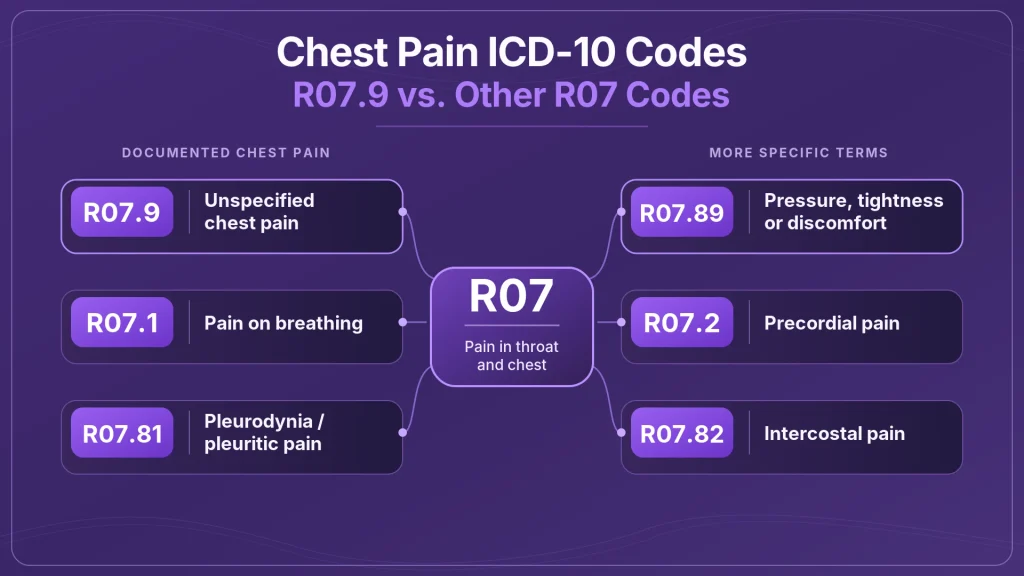
| Code | Title | Billable | Terms That Lead Here (Tabular and Index) |
|---|---|---|---|
| R07.0 | Pain in throat | Yes | Pain in throat; acute sore throat documented as acute pharyngitis may be classified under J02.9. |
| R07.1 | Chest pain on breathing | Yes | Painful respiration; diaphragmalgia |
| R07.2 | Precordial pain | Yes | Precordial pain |
| R07.8 | Other chest pain | No (header) | Use R07.81, R07.82 or R07.89 |
| R07.81 | Pleurodynia | Yes | Pleurodynia NOS; pleuralgia; pleural or pleuritic pain |
| R07.82 | Intercostal pain | Yes | Intercostal pain |
| R07.89 | Other chest pain | Yes | Anterior chest-wall pain NOS; chest discomfort, pressure or tightness; atypical, musculoskeletal or non-cardiac chest pain; rib pain |
| R07.9 | Chest pain, unspecified | Yes | Chest pain or central chest pain with no further description |
Chest Pain on Breathing (R07.1)
R07.1 is for pain that the provider ties to breathing itself, such as “chest pain on inspiration” or “painful respiration.” The Index also sends diaphragmalgia here. It is a respiratory-linked symptom code, not a diagnosis of pleurisy or pneumonia.
Precordial Pain (R07.2)
R07.2 applies when the provider specifically describes the pain as precordial, meaning over the front of the heart. The word must come from the provider. A coder should not convert “left chest pain” into precordial pain because the two areas overlap on a diagram.
Pleurodynia (R07.81)
R07.81 covers pleurodynia, pleuralgia and pain the provider calls pleural or pleuritic. It has its own Excludes1 note for epidemic pleurodynia (B33.0), the viral illness also called Bornholm disease, so a documented viral cause moves the code to B33.0.
Intercostal Pain (R07.82)
R07.82 is for pain the provider locates between the ribs and describes as intercostal. When the provider names a specific musculoskeletal condition, such as a rib fracture or muscle strain, that condition is coded instead.
Other Specified Chest Pain (R07.89)
R07.89 is the “other specified” code, and it holds more everyday terms than most coders expect. The Tabular lists anterior chest-wall pain NOS, and the Alphabetic Index sends chest discomfort, chest pressure, chest tightness, rib pain and atypical, musculoskeletal or non-cardiac chest pain here as well.
Unspecified Chest Pain (R07.9)
R07.9 is the default for “chest pain” with no further description. The Index lists “central” as a nonessential modifier, so “central chest pain” also codes to R07.9. Any additional detail that matches a subterm moves the code to R07.1, R07.2, R07.81, R07.82 or R07.89.
What is the difference between R07.9 and R07.89? R07.89 means the provider described the chest pain in a way the classification recognizes but has no dedicated code for, such as pressure, tightness or chest wall pain. R07.9 means the provider gave no description at all. One word in the note, such as “tightness,” is enough to move a claim from R07.9 to R07.89.Chest pain is one of several pain-related symptoms classified under ICD-10-CM. For a broader understanding of site-specific symptoms, chronic pain and related coding requirements, explore our ICD-10-CM pain diagnosis codes guide.
A word of caution on pleuritic pain. Several coding sites say “pleuritic chest pain” belongs to R07.1. The Alphabetic Index disagrees: under Pain, pleura, pleural, pleuritic, it points to R07.81. Pleurisy itself is different again and indexes to R09.1. Always follow the documented term through the Index and confirm it in the Tabular, as Section I.B.1 requires.
How Do Chest Pain Location and Symptoms Affect ICD-10 Code Selection?
Location, timing, radiation and quality are the details providers document most often, and they matter clinically. In ICD-10-CM, though, most of them do not change the code. The R07 family has no left or right codes and no codes for acute versus chronic pain. These details support medical necessity and help the provider reach a diagnosis, but they never establish a cardiac diagnosis on their own.
Upper and Central Chest Pain
“Central” is a nonessential modifier in the Index, so central chest pain codes to R07.9. “Upper chest pain” has no Index subterm either and also defaults to R07.9 unless the provider adds a description such as pressure, tightness or chest wall pain.
Left-Sided Chest Pain
There is no separate code for left-sided chest pain. Documented as “left-sided chest pain” alone, it codes to R07.9. If the provider writes “left precordial pain,” R07.2 applies, and if the provider writes “left anterior chest wall pain,” R07.89 applies. The side is part of the clinical picture, not the code.
Right Sided Chest Pain
The same rule applies on the right. Right-sided chest pain without further description is R07.9. Right-sided pain the provider calls pleuritic is R07.81, and right-sided pain on breathing is R07.1.
Acute Chest Pain
ICD-10-CM does not split chest pain by onset, so “acute chest pain” codes to R07.9 when nothing else is documented. Duration still belongs in the note, because it is one of the factors a reviewer uses to judge whether the workup was medically necessary.
Chest Pain Radiating to the Left Arm
Radiation does not have its own code. Chest pain radiating to the left arm codes to R07.9, or to R07.89 if the provider also describes it as pressure or tightness. When the arm pain is simply the radiation of the chest pain, it is part of the same complaint and is not coded separately. Radiation is a classic warning sign, but until the provider documents a diagnosis such as angina or MI, the coder reports the symptom.
Atypical Chest Pain and Chest Discomfort
The Index sends both “atypical chest pain” and “chest discomfort” to R07.89. There is a clinical wrinkle worth knowing here. The 2021 AHA/ACC Guideline for the Evaluation and Diagnosis of Chest Pain calls “atypical” a misleading descriptor and recommends describing chest pain as cardiac, possibly cardiac or noncardiac instead. For coding, “noncardiac” still lands on R07.89. “Possibly cardiac” is an uncertain diagnosis, so outpatient coders report the symptom rather than the suspected cardiac condition.

What Medical Conditions Cause Chest Pain and How Are They Coded?
Chest pain has dozens of possible causes. The table below shows the most common ones and the code family each belongs to. These codes only replace a chest pain code when the provider documents the condition as confirmed, or, for inpatient stays, as an uncertain diagnosis at discharge under Section II.H.
| Condition | Code Family | What Documentation Must Show |
|---|---|---|
| Unstable angina | I20.0 | Provider states unstable angina |
| Angina, other forms or unspecified | I20.1, I20.2, I20.81, I20.89, I20.9 | Type of angina; I20.8 is now a header |
| CAD with angina | I25.110 to I25.119 | CAD and angina; one combination code covers both |
| Acute MI (STEMI, NSTEMI, type 2 and MI with coronary microvascular dysfunction) | I21.0–I21.4, I21.9, I21.A1, I21.A9, I21.B | Provider confirmed MI, its type and applicable additional details |
| Pulmonary embolism | I26.- | PE confirmed; with or without acute cor pulmonale |
| Pneumonia | J12 to J18 | Pneumonia confirmed; organism if known |
| Pneumothorax | J93.- | Type (spontaneous, other) |
| GERD | K21.00, K21.01, K21.9 | With or without esophagitis and bleeding |
| Esophagitis | K20.- | Type and bleeding status |
| Esophageal spasm | K22.4 | Spasm or dyskinesia of esophagus |
| Costochondritis | M94.0 | Costochondritis or Tietze syndrome |
| Rib fracture or chest contusion | S22.3-, S22.4-, S20.2- | Site, number of ribs, laterality, 7th character |
| Anxiety or panic disorder | F41.0, F41.1, F41.9 | Provider links the pain to the diagnosed disorder |
| Herpes zoster (shingles) | B02.- | Zoster confirmed; any complication |
The FY 2027 ICD-10-CM guidelines also address code I21.B for myocardial infarction with coronary microvascular dysfunction. This code applies when the documented diagnosis meets its classification requirements. Medical coders should distinguish it from type 1 myocardial infarction, type 2 myocardial infarction and other acute ischemic heart conditions before selecting the appropriate code.
Cardiac Conditions: Angina Pectoris (I20.-), Acute Myocardial Infarction (I21.-) and Coronary Artery Disease
Two details trip up even experienced coders. First, the FY 2024 update turned I20.8 into a header, so stable or other angina now codes to I20.89 and angina with coronary microvascular dysfunction to I20.81. Second, when a patient has coronary artery disease with angina, Section I.C.9.b directs you to a single combination code from I25.11-, with no separate I20 code, and it presumes the CAD caused the angina unless the provider says otherwise. For MI, I21 codes apply for four weeks (28 days) from onset under Section I.C.9.e.
Pulmonary Conditions: Pulmonary Embolism, Pneumonia and Pneumothorax
Each of these is coded from its own category once confirmed: I26.- for pulmonary embolism, J12 to J18 for pneumonia and J93.- for pneumothorax. Chest pain is an expected symptom of all three, so it is generally not coded separately once the diagnosis is made.
Gastrointestinal Conditions: GERD, Esophagitis and Esophageal Spasm
GERD codes changed in FY 2021, and some guides never caught up. K21.0 is no longer a valid code; it splits into K21.00 (with esophagitis, without bleeding) and K21.01 (with esophagitis, with bleeding), while K21.9 covers GERD without esophagitis. Esophageal spasm codes to K22.4, dyskinesia of esophagus.
Musculoskeletal Conditions: Costochondritis, Chest Wall Injury and Rib Fractures
Costochondritis codes to M94.0. Traumatic causes move to Chapter 19: S22.3- for a single rib fracture, S22.4- for multiple rib fractures and S20.2- for a chest wall contusion, each with the right 7th character and an external cause code where required. Nontraumatic rib pain without a diagnosis stays in R07.89.
Other Possible Causes: Anxiety, Panic Disorder and Herpes Zoster
Anxiety (F41.9), generalized anxiety disorder (F41.1) and panic disorder (F41.0) only replace the chest pain code when the provider links the pain to that diagnosis. Thoracic shingles without complications codes to B02.9; if the pain persists after the rash as postherpetic neuralgia, the provider’s wording decides the B02.2- code.

When Should Chest Pain Be Coded as a Symptom Instead of a Confirmed Diagnosis?
This is the question that matters most, and it comes down to what the provider confirmed by the end of the encounter.
When Is a Symptom Code Appropriate?
Section I.B.4 allows symptom codes when a related definitive diagnosis has not been established by the provider. Section I.C.18.a repeats that rule for Chapter 18 codes. If the workup is incomplete, the results are normal or the provider simply does not know yet, R07 is correct.
When Should a Confirmed Diagnosis Replace R07.9?
When a healthcare provider establishes a definitive diagnosis that explains the patient’s chest pain, the coder must determine whether chest pain is routinely associated with that condition. Under Section I.B.5 of the FY 2027 ICD-10-CM guidelines, symptoms routinely associated with a confirmed disease are generally not reported separately unless the classification instructs otherwise.
For example, chest pain is typically integral to angina pectoris. When angina is confirmed and explains the presenting symptoms, an additional R07.9 code is generally unnecessary. However, chest pain should not automatically be excluded whenever another diagnosis is documented. Coders must review the provider’s assessment, the relationship between the conditions and applicable reporting instructions.
Can Chest Pain and Its Underlying Diagnosis Be Reported Together?
Only when the symptom is not routinely part of the diagnosis. Section I.B.6 and Section I.C.18.b allow a symptom code alongside a definitive diagnosis when the symptom is not routinely associated with it. A patient seen for a confirmed ankle fracture who also reports chest pain is an example, because chest pain is not part of an ankle fracture. Chest pain with angina is not, because angina is chest pain.
What Happens When the Cause of Chest Pain Remains Unknown?
When the underlying cause of chest pain remains undetermined, coders should report the most specific symptom code supported by the provider’s documentation and the applicable encounter-setting rules. If no more specific description is available, R07.9 may be appropriate.
For inpatient admissions, Section II.D of the FY 2027 ICD-10-CM guidelines addresses rare situations involving comparative or contrasting diagnoses documented as either/or. These conditions may be coded as established, with sequencing determined by the circumstances of admission. If the documentation does not clearly establish which condition was chiefly responsible for the admission after study, the coder must apply the appropriate principal diagnosis guidelines and query the provider when necessary.

How Does Chest Pain Coding Differ Between Outpatient and Inpatient Settings?
The same note can produce different codes depending on the setting, because the FY 2027 guidelines treat uncertain diagnoses differently inside and outside the hospital.
Chest Pain Coding in Physician Offices and Outpatient Clinics
Section IV governs these visits. Section IV.H says not to code diagnoses documented as probable, suspected, questionable, rule out or working diagnosis, and instead to code to the highest degree of certainty for that visit. “Chest pain, rule out MI” therefore codes to the chest pain symptom, never to I21.-.
Chest Pain Coding in Emergency Departments and Observation
Emergency department visits and observation stays are outpatient services, so Section IV still applies, including IV.H. Section IV.A.2 covers observation stays specifically. A patient held overnight in observation for chest pain with negative troponins is coded from the symptom, even if the note mentions a suspected cardiac cause.
Emergency department claims involve more than diagnosis selection. The reported E/M services, medical necessity and documentation must also meet applicable billing requirements. Our CMS emergency room billing guidelines explain these considerations for emergency care providers.
Chest Pain Coding for Inpatient Hospital Admissions
Once a patient is formally admitted, Sections II and III apply. Section II.A says a symptom code should not be the principal diagnosis when a related definitive diagnosis has been established. If the patient is admitted from observation, Section II.I points the coder to inpatient principal diagnosis rules.
How Are Suspected, Probable and Rule-Out Diagnoses Coded?
Under Section II.H, when a diagnosis at the time of inpatient discharge is qualified as probable, suspected, likely, questionable, possible, still to be ruled out, compatible with or consistent with, it is coded as if it existed. This applies to inpatient admissions to short-term, acute, long-term care and psychiatric hospitals. It never applies to outpatient claims.
| Encounter | Provider Documentation | Coding Principle |
|---|---|---|
| Outpatient | Chest pain, rule out MI | Do not report the MI; code the documented chest pain (Section IV.H) |
| Observation | Chest pain, possible unstable angina, troponins negative | Outpatient rules apply; code the symptom (Sections IV.A.2 and IV.H) |
| Inpatient discharge | Probable NSTEMI after workup | Code the NSTEMI as established (Section II.H) |
| Outpatient | Confirmed costochondritis causing chest pain | Report M94.0 only; chest pain is integral (Section I.B.5) |

What Should Physicians Document for Accurate Chest Pain Coding?
Every code in this guide depends on the words in the note. These four areas cover what a coder needs.
Pain Location, Character, Duration and Radiation
Record where the pain is, what it feels like (pressure, tightness, sharp, burning), how long it has lasted and where it spreads. The character words matter most for coding, because “pressure” or “tightness” moves the code to R07.89 and “on inspiration” moves it to R07.1.
Associated Symptoms and Clinical Findings
Shortness of breath, nausea, diaphoresis and palpitations support the medical necessity of the workup. Symptoms that are not part of the final diagnosis may be coded separately; symptoms that are part of it may not.
Diagnostic Testing and the Final Provider Assessment
ECG, troponin and imaging results explain the provider’s thinking, but Section I.A.19 is explicit that code assignment is based on the provider’s diagnostic statement. A coder should never assign an MI because troponin is elevated or an ECG shows ST changes. The final assessment, in the provider’s own words, is what gets coded.
When Should a Medical Coder Query the Physician?
Query when the documentation conflicts, such as “chest pain, noncardiac” in one section and “angina” in another, or when test results suggest a diagnosis the provider never addressed. The guidelines require a query for conflicting documentation, and a compliant query should present the facts without leading the provider toward a particular answer.
| Documentation Checklist | Why It Matters for the Code |
|---|---|
| Character of pain (pressure, tightness, sharp, burning) | May support a more specific code when the documented terminology matches an ICD-10-CM Index entry |
| Relationship to breathing | Supports R07.1 |
| Provider’s own term (precordial, pleuritic, intercostal) | Supports R07.2, R07.81 or R07.82 |
| Final assessment with diagnosis or “cause unknown” | Decides symptom versus diagnosis |
| Certainty words (rule out, probable, confirmed) | Applies Section IV.H or II.H |
| Encounter setting (office, ED, observation, inpatient) | Decides which guideline section applies |
What Are the Official ICD-10-CM Guidelines for Chest Pain Coding in 2027?
You do not need the whole 121-page manual to code chest pain. These are the FY 2027 rules that actually change the answer.
Using the Alphabetic Index and Tabular List
Section I.B.1 requires both: find the documented term in the Index, then verify the code and its notes in the Tabular. This is how “pleuritic pain” reaches R07.81 instead of R07.1 and how “chest tightness” reaches R07.89.
Selecting the Highest Supported Level of Specificity
Section I.B.2 (and Section IV.F.3 for outpatient claims) requires coding to the highest specificity documented. Choosing R07.9 when the note says “chest pressure” is under-coding. Choosing R07.2 when the note only says “left chest pain” is over-coding.
Excludes1, Excludes2 and Combination Code Instructions
Excludes1 means the two codes never go together, such as R07.81 and B33.0. Excludes2 means both may be coded if both exist, such as chest pain and jaw pain. Section I.B.9 says to use a single combination code when one exists, which is why CAD with angina is one I25.11- code.
First-Listed and Principal Diagnosis Sequencing
For outpatient encounters, Section IV provides guidance on selecting the first-listed diagnosis based on the condition, symptom or reason chiefly responsible for the services provided. For inpatient admissions, Section II.A states that Chapter 18 symptom codes should not be used as the principal diagnosis when a related definitive diagnosis has been established. Section II.D addresses qualifying comparative or contrasting inpatient diagnoses, while Section II.H explains how uncertain diagnoses documented at discharge are reported. Coders must apply these rules according to the encounter setting and final provider documentation.
How to Select the Correct Chest Pain ICD-10 Code: A Step-by-Step Workflow
Run every chest pain encounter through these five steps in order.
| Step | Question | If Yes | If No |
|---|---|---|---|
| 1 | What is the setting: outpatient (office, ED, observation) or inpatient admission? | Outpatient: use Section IV rules | Inpatient: use Sections II and III |
| 2 | Has the provider established a related definitive diagnosis? (Inpatient: includes uncertain diagnoses at discharge under II.H) | Code the diagnosis; go to step 3 | Go to step 4 |
| 3 | Is chest pain routinely part of that diagnosis? | Do not code chest pain separately | Consider additional symptom reporting if the symptom is separately reportable |
| 4 | Does the provider’s wording match an Index subterm (on breathing, precordial, pleuritic, intercostal, pressure, tightness, wall)? | Assign R07.1, R07.2, R07.81, R07.82 or R07.89 | Assign R07.9 |
| 5 | Have you checked the Tabular notes, sequencing and certainty words? | Proceed to claim level validation before submission | Recheck or query the provider |
Practical Chest Pain ICD-10 Coding Scenarios
These hypothetical scenarios show how the workflow plays out with real-world wording.
| Scenario | Provider Wording | Reasoning and Rule | Code |
|---|---|---|---|
| 1. Outpatient, cause unknown | “Chest pain. ECG and troponin normal. Refer to cardiology.” | No diagnosis, no qualifying description (I.B.18) | R07.9 |
| 2. Radiation, no diagnosis | “Left-sided chest pain radiating to left arm, rule out ACS.” | Outpatient: rule-out not coded (IV.H); radiation has no code | R07.9 |
| 3. Pain on breathing | “Sharp chest pain on deep inspiration, lungs clear, no diagnosis yet.” | Matches Index subterm “on breathing” (I.B.1) | R07.1 |
| 4. Confirmed cause | “Reproducible chest wall tenderness. Assessment: costochondritis.” | Chest pain integral to diagnosis (I.B.5) | M94.0 |
| 5. Inpatient probable diagnosis | Discharge summary: “Probable NSTEMI.” | Inpatient uncertain diagnosis coded as established (II.H) | I21.4 |
Selecting the correct diagnosis code does not complete the billing process. Before submission, claim scrubbing in medical billing helps identify missing information, coding inconsistencies and payer-specific claim errors that could otherwise delay processing.
What Are the Most Common Chest Pain ICD-10 Coding Mistakes?
Most chest pain errors fall into five patterns.
Choosing R07.9 When More Specific Documentation Is Available
Words like pressure, tightness, discomfort, pleuritic or chest wall all move the code away from R07.9. Defaulting to the unspecified code when the note supports a specific one fails Section I.B.2.
Coding an Unconfirmed Diagnosis in an Outpatient Setting
Reporting a suspected myocardial infarction as a confirmed diagnosis on an outpatient claim is a significant coding error. Outpatient claims code the symptom; only inpatient discharges can code a probable diagnosis as established.
Assigning Symptoms Separately When They Are Integral to a Diagnosis
Reporting R07.9 next to I20.9, I21.4, K21.9 or M94.0 adds nothing and breaks Section I.B.5. The diagnosis already tells the payer there was chest pain.
Inferring a Diagnosis From Chest Pain Location or Test Results
Left arm radiation does not make it angina, and an elevated troponin does not make it an MI. Only the provider’s diagnostic statement can, under Section I.A.19.
Missing Documentation Conflicts and Sequencing Instructions
Conflicting clinical documentation may require a compliant provider query rather than an unsupported coding assumption. For inpatient admissions involving qualifying comparative or contrasting diagnoses, Section II.D governs diagnosis selection and sequencing. Another common error involves coronary artery disease with angina, where the appropriate I25.11- combination code generally captures both conditions without requiring a separate I20 code, subject to the applicable ICD-10-CM instructions.

How Does Accurate Chest Pain Coding Affect Medical Billing and Claim Denials?
R07.9 does not cause denials on its own. It is a valid, billable code, and many payer policies list chest pain codes as supporting medical necessity for services like ECGs and cardiac testing. Claims get denied when the diagnosis does not support the specific service billed under that payer’s coverage policy, when an outpatient claim carries an unconfirmed diagnosis or when a required character or combination code is missing.
It also helps to separate coding denials from everything else. Eligibility problems, missing prior authorizations, frequency limits and coverage exclusions all deny chest pain claims too, and no diagnosis code fixes them. Accurate documentation and code selection protect you from the coding side of the problem, which is the part your team controls.
What Should Medical Coders Check in the FY 2027 ICD-10-CM Guidelines?
The FY 2027 code set and Official Guidelines apply to dates of service and discharges from October 1, 2026 through September 30, 2027. Before coding chest pain claims for this period, confirm three things: that each code is valid in the FY 2027 Tabular, that your encoder and claim scrubber have loaded the October 1 update and that your team has reviewed the narrative changes, which appear in bold in the official guidelines PDF published by CDC and CMS. Always pull code titles from the official FY 2027 files rather than from a third-party list.
Conclusion
R07.9 is the ICD-10-CM code for unspecified chest pain, but selecting the correct code requires more than identifying the patient’s symptoms. Medical coders must consider the provider’s documented terminology, confirmed diagnoses and encounter setting. Following the FY 2027 ICD-10-CM guidelines helps support accurate diagnosis reporting, documentation consistency and compliant medical billing.

Frequently Asked Questions About Chest Pain ICD-10 Codes
What is the difference between R07.9 and R07.89?
R07.9 is chest pain with no further description. R07.89 is chest pain the provider describes in a recognized but unassigned way, such as pressure, tightness, discomfort, chest wall pain or noncardiac chest pain. See the Category R07 section above for every term that leads to each code.
Is there a separate ICD-10 code for left-sided chest pain?
No. ICD-10-CM has no left or right chest pain codes. Left-sided chest pain without further description codes to R07.9, and added terms such as precordial or chest wall move it to R07.2 or R07.89.
What ICD-10 code applies to chest pain radiating to the left arm?
Without a confirmed diagnosis, it codes to R07.9, or R07.89 if described as pressure or tightness. Radiation has no separate code and the arm pain is not coded on its own when it is part of the chest pain.
Is R07.9 acceptable as a first-listed diagnosis?
Yes. R07.9 is billable and can be first-listed on outpatient claims when no related diagnosis is confirmed. On inpatient claims, it can be principal only when no related definitive diagnosis is established, under Section II.A.
Can a provider report both chest pain and angina?
Not usually. Chest pain is integral to angina, so Section I.B.5 says to code only the angina. For CAD with angina, use a single I25.11- combination code with no separate I20 code.
What is the ICD-10 code for chest tightness?
Chest tightness codes to R07.89, Other chest pain. The Alphabetic Index sends chest tightness, chest pressure and chest discomfort to R07.89 when no underlying diagnosis has been confirmed.