
Family therapy claims fail for small reasons. The patient stepped out halfway through, so was it 90846 or 90847? Mom, dad and two siblings attended, so is that four units? The session ran 22 minutes because the family arrived late. Each of these questions has a clear answer, and getting it wrong turns a routine claim into a denial or a payback.
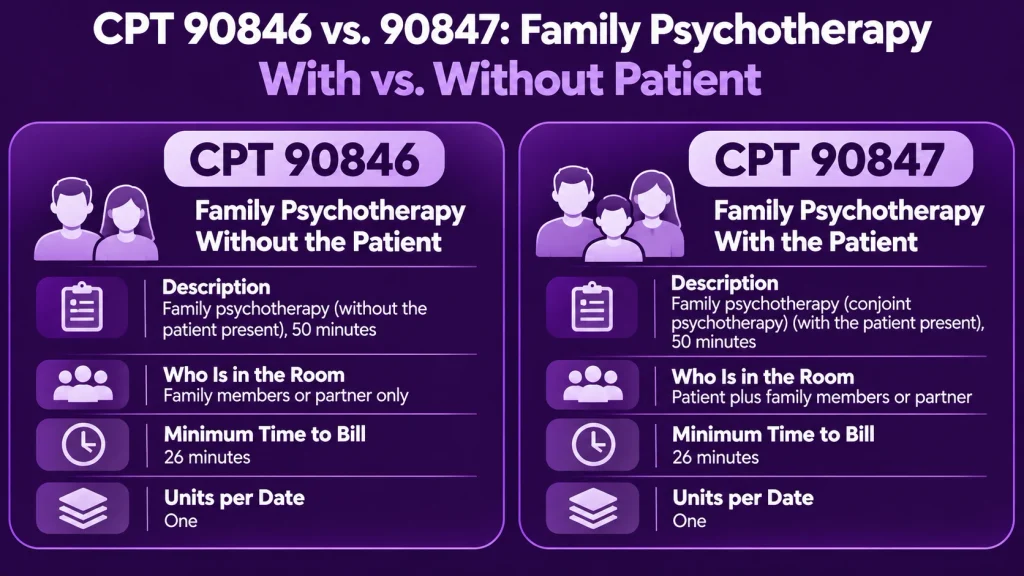
CPT 90846 involves performing psychotherapy with family members or couples when the patient is absent. CPT 90847 pertains to psychotherapy with family members or couples when the patient is present. Both codes refer to 50-minute services that may be billed if 26 minutes have been performed on one date of service regardless of the number of participants.
Let’s break down the descriptions, time ranges, documentation, Medicare rules and the 2027 payment changes that make these codes worth more than they were last year.
CPT 90846 vs 90847
| Point | CPT 90846 | CPT 90847 |
|---|---|---|
| Description | Family psychotherapy (without the patient present), 50 minutes | Family psychotherapy (conjoint psychotherapy) (with the patient present), 50 minutes |
| Who is in the room | Family members or partner only | Patient plus family members or partner |
| Minimum time to bill | 26 minutes | 26 minutes |
| Units per date | One | One |
| Whose insurance | The identified patient’s | The identified patient’s |
| Interactive complexity (90785) | Not reported with this code | Not reported with this code |
| Medicare national amount, 2027* | $120.73 (full fee schedule) | $125.29 (full fee schedule) |
National non-facility amounts before geographic adjustment, as calculated by TherapistRates from the CMS RVU27A file. LCSWs, LMFTs and LPCs/LMHCs are paid 75% of these amounts.
CPT code 90846: family therapy without the patient
90846 CPT code description
The CPT code 90846 description is family psychotherapy (without the patient present), 50 minutes. The “patient” is the person whose diagnosis drives the treatment, often called the identified patient. The therapist meets with the family, a parent or a partner to work on the patient’s condition while the patient is not in the room.
Typical uses include coaching parents of a child with ADHD on behavior plans, working with a spouse when the patient’s presence would derail the session or helping family members respond to a relapse in a substance use disorder.
90846 CPT code time range
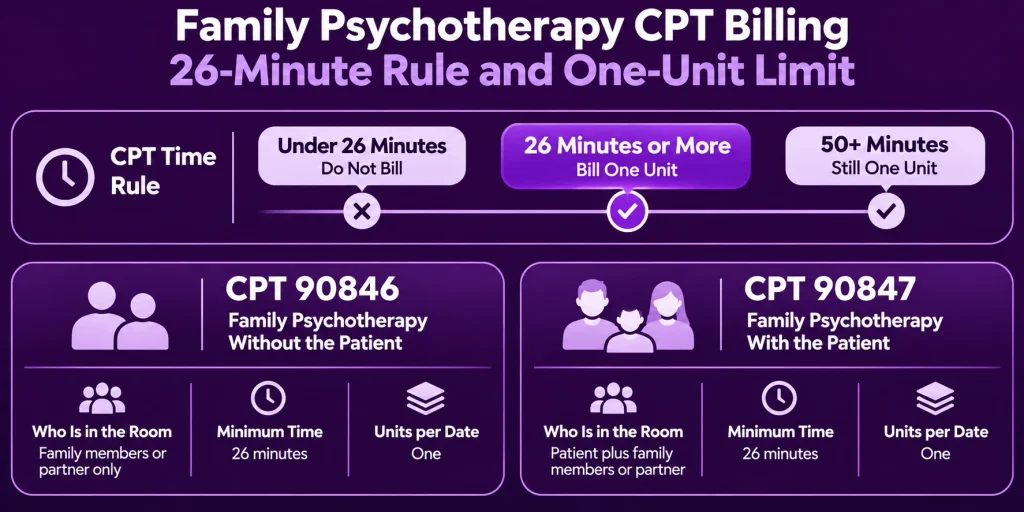
90846 describes 50 minutes, but CPT’s time rule lets you report it once you pass the midpoint. That means the 90846 CPT code time range starts at 26 minutes. There’s no upper limit and no add-on code for a longer family session, so a 75-minute session is still one unit.
Documentation is key: The note must say the patient was not present, who attended, start and stop times (or total minutes) and how the session addressed the patient’s treatment goals.
CPT code 90847: family therapy with the patient
90847 CPT code description
CPT 90847 is family psychotherapy (conjoint psychotherapy) (with the patient present), 50 minutes. It’s the 90847 billing code you use for most couples therapy and family sessions where the identified patient takes part, such as a teen with depression in a session with both parents.
90847 CPT code time range
Like 90846, the 90847 CPT code time range starts at 26 minutes and has no maximum. Under 26 minutes, you can’t report 90847. Some payers and older articles quote 50 minutes as a minimum, but that’s the descriptor time, not the reporting threshold under CPT.
What if the patient leaves partway through?
Pick the code that matches who was present for most of the session, and document it. A Medicare compliance checklist based on LCD L33252, for example, lists “patient present for majority of the service” among its family psychotherapy documentation items.
How to avoid? Write the times the patient joined and left. “Patient present for 40 of 52 minutes” settles the code choice before anyone asks.
How many units of 90846 or 90847 can you bill?
One. You bill one unit of the family therapy code per date of service, no matter how many family members attend or how long the session runs. Five family members in the room is still one unit of 90847, billed under the identified patient.
If several families meet together in a group, the right code is 90849 (multiple-family group psychotherapy), not 90847.
Can you bill 90847 and individual therapy on the same day?
Often yes, when they are truly separate sessions. A 45-minute individual session (90834) followed later by a 50-minute family session (90847) is two distinct services. Many payers accept both, but some bundle them or require modifier 59 or XE to show a separate encounter. Document each session with its own times and goals.
How to avoid? Don’t split one continuous session into an individual piece and a family piece to bill two codes. If it was one meeting, it’s one code.

Medicare rules for family psychotherapy
Medicare covers family psychotherapy when the primary purpose is treating the patient’s condition. LCD L33252 describes it as medically reasonable when the patient has a psychiatric illness or symptoms causing maladaptive functioning, for example when the therapist needs to observe and correct the patient’s interaction with family members. It is not covered when the patient is unconscious or comatose, and sessions focused on recreation, grooming skills or social interaction don’t qualify.
Since January 1, 2024, licensed marriage and family therapists and mental health counselors can bill Medicare directly, which brought many more family therapists into Medicare billing. They are paid at 75% of the physician fee schedule amount, the same as clinical social workers.
What’s changing for 90846 and 90847 in 2027?
Higher Medicare payment
Even with the 2027 conversion factor dropping to $32.6286, family therapy pays more. TherapistRates’ calculation from the CMS files shows the national non-facility amount for 90847 rising from $109.55 in 2026 to $125.29 in 2027 (about 14%), and 90846 rising from $105.88 to $120.73. Part of the reason is the psychotherapy work RVU increase CMS finalized in 2024 and phased in over four years, with 2027 as the final step.
| Code | 2026 | 2027 | LCSW / LMFT / LPC (75%), 2027 |
|---|---|---|---|
| 90847 | $109.55 | $125.29 | $93.97 |
| 90846 | $105.88 | $120.73 | $90.55 |
These are national amounts before your locality’s adjustment. Your Medicare Administrative Contractor’s fee schedule shows your actual rate.
A status change for 90846
In 2026, 90846 carried Medicare status “R” (restricted coverage), meaning special coverage instructions applied and payment was contractor priced if covered. TherapistRates reports that the January 2027 CMS RVU file lists 90846 with status “A,” an active code paid separately under the fee schedule if covered. Check your MAC’s guidance before you change how you bill 90846 to Medicare.
Diagnosis codes for family and couples therapy
The claim goes under the identified patient, with that patient’s mental health diagnosis. For couples therapy, one partner must be the identified patient with a diagnosis such as major depressive disorder, generalized anxiety disorder or an adjustment disorder.
Relationship Z codes, such as Z63.0 (problems in relationship with spouse or partner), describe the issue but many payers won’t pay them as the primary diagnosis. If the only issue is the relationship, the session may not meet medical necessity, and the couple may need to pay out of pocket.
Documentation is key: Tie every family session to the patient’s treatment plan. “Discussed family communication” isn’t enough. “Worked with parents on consistent response to patient’s panic symptoms per treatment goal 2” is.
Telehealth billing for 90846 and 90847
Both codes are commonly covered by telehealth. Most payers want modifier 95 for synchronous video and the place of service that matches where the patient is: POS 10 when the patient is at home and POS 02 when the patient is somewhere else. Some payers still use different modifiers or rules, so confirm each plan’s telehealth policy.
With family telehealth, document where each participant joined from. A session where the patient and parents are in different homes is still one unit of 90847.
Practical family therapy coding scenarios
Scenario 1: Parents only. The therapist meets with the parents of a 12-year-old with ADHD for 45 minutes to set up a home behavior plan. The child isn’t present. Code: 90846. Why: family session focused on the patient’s treatment, patient absent, over 26 minutes.
Scenario 2: Teen and both parents. A 16-year-old with major depression attends a 50-minute session with her parents. Code: 90847. Why: patient present for the whole session.
Scenario 3: Large family. The patient, both parents and two siblings attend for 55 minutes. Code: 90847, one unit. Why: units don’t increase with the number of family members.
Scenario 4: Short session. The family arrives late, and the session lasts 22 minutes. Code: none for family psychotherapy. Why: under the 26-minute threshold.
Scenario 5: Individual and family session on the same day. The patient has a 40-minute individual session in the morning and a separate 50-minute family session in the afternoon. Code: 90834 and 90847, with modifier 59 or XE if the payer requires it. Why: two distinct sessions with separate documentation.
Scenario 6: Couples therapy for a relationship issue only. A couple wants help communicating, and neither partner has a mental health diagnosis. Code: usually not billable to insurance. Why: there’s no identified patient with a covered diagnosis.
Common 90846 and 90847 billing mistakes
Billing one unit per family member. How to Avoid? Bill one unit per date, under the identified patient.
Billing under 26 minutes. How to Avoid? Record start and stop times and check them before you code.
Using 90847 when the patient wasn’t there. How to Avoid? Make patient presence a required field in the note template.
Adding 90785 to family codes. How to Avoid? Interactive complexity isn’t reported with 90846 or 90847.
Using a relationship Z code as the only diagnosis. How to Avoid? Use the identified patient’s treatable diagnosis and link the session to the treatment plan.
Using 90847 for multi-family groups. How to Avoid? Use 90849 when several families meet together.

Conclusion
The difference between CPT 90846 and 90847 comes down to one question: was the patient in the room? Without the patient, it’s 90846. With the patient, it’s 90847. Both need at least 26 minutes, both are one unit per date and both are billed under the identified patient’s diagnosis. In 2027, Medicare pays more for both codes. 90846 also moves to active status in the CMS files, so update your fee schedules and check your MAC’s guidance before the new year.
Frequently asked questions
What is CPT code 90846?
CPT code 90846 is family psychotherapy without the patient present, 50 minutes. The therapist meets with family members or a partner to address the identified patient’s condition while the patient is not in the session.
What is CPT 90847?
CPT 90847 is family or couples psychotherapy with the patient present, 50 minutes. It is used when the identified patient takes part in the session with family members or a partner.
What is the 90847 CPT code time range?
90847 can be reported once at least 26 minutes of family psychotherapy are documented. There is no maximum time, and longer sessions are still billed as one unit.
What is the 90846 CPT code time range?
90846 also requires at least 26 minutes, the midpoint of its 50-minute descriptor. Sessions under 26 minutes can’t be billed with 90846.
Can you bill 90847 for each family member?
No. Bill one unit of 90847 per date of service under the identified patient, regardless of how many family members attend.
Does Medicare pay for 90846 and 90847?
Medicare covers family psychotherapy when its main purpose is treating the patient’s condition. 90847 is an active code. 90846 was restricted (status R) in 2026, and TherapistRates reports it is listed as active (status A) in the 2027 CMS file, so confirm coverage with your MAC.
Can couples therapy be billed with 90847?
Yes, when one partner is the identified patient with a covered mental health diagnosis and the session treats that condition. Relationship counseling with no diagnosed patient usually isn’t covered.